
Understanding how your logged miles are counted is essential when working toward an international certificate. Whether you are aiming for the German SKS, the Swiss Hochseeschein, or the RYA Yachtmaster, you will need to present a logbook before certification.
To accumulate these numbers quickly, many aspiring skippers turn to commercial “Mile Builders” (Meilentörns). Providers often market these alongside an “Offizieller Meilennachweis” (Official Mileage Confirmation). In the German-speaking market, this phrasing is remarkably effective at driving bookings. However, it creates a false impression that private miles are legally inferior. In fact, any passage completed on an eligible boat is entirely legitimate.
In reality, this narrative obscures how the system actually works. More importantly, it often steers developing sailors into a loop where their logbook numbers grow while their practical competence remains stagnant.
The Legal Framework: Flag States and Paperwork
Let’s look at the objective legal framework of European maritime authorities. Neither the German Sailing Association (DSV), the Swiss Maritime Navigation Office (SSA), nor the RYA requires an endorsement from a commercial school to validate your sea miles.
- The German Framework (SKS/SSS): The DSV explicitly states that a mileage confirmation (Seemeilenbestätigung) is entirely formless. It requires no corporate logo, club seal, or school accreditation. It simply requires the vessel’s data, dates, nautical miles run, and the signature of the skipper in command.
- The Swiss Framework (Hochseeausweis): The SSA requires miles to be logged in a standardised format, typically the Fahrtennachweis booklet. Crucially, any legitimate skipper can sign this booklet. The authorities do not look at whether the skipper operates a commercial company or sails privately. As long as the entry matches the yacht’s official state registration and bears the skipper’s signature, it is legally valid.
- The RYA: For higher-level RYA certificates (Yachtmaster), you are specifically required to have self-skippered a minimum number of miles/passages before presenting yourself for the exam.
In short, any skipper who can legally sail the boat is entitled to sign a logbook. The validity of a mile rests on the rules of flag state legislation, not a commercial school stamp. The claim that school-run miles are inherently “more official” is simply marketing.
The Uncertified Skipper Loophole
This international framework can lead to fascinating bureaucratic paradoxes. As we explain in our guide to Sailing Certifications Explained, some of the countries with the most notoriously dangerous coastlines in Europe—such as the UK and Ireland—require zero mandatory licensing or formal certification for private recreational vessels under a certain size.
Consequently, under Swiss law, an uncertified skipper on a UK-flagged private boat can legally sign your Swiss Fahrtennachweis. Yet, the system bars you from submitting your own self-skippered miles. This applies even when you are certified to operate the vessel.
The Coastal Disconnect: A Modern Administrative Paradox
This administrative rigidity creates an interesting contradiction following recent updates to Swiss maritime legislation. The SSA progressively unbundled High Seas Navigation (Hohe See) from Coastal Navigation (Küstenfahrt). This legalised the use of certificates like the RYA Day Skipper or German SKS to skipper a Swiss-flagged yacht in coastal waters.
Yet, while the Swiss government now fully recognises you as the legal skipper of the Vessel on a coastal cruise, the regulations governing the Hochseeausweis mileage logbook operate on a completely separate set of traditional rules. The SSA treats the Fahrtennachweis strictly as a third-party performance evaluation (Leistungsnachweis); you cannot legally act as your own evaluator. The system dictates that self-skippered miles cannot be counted toward the initial certificate. This entirely discounts the exact miles where you carried total operational and legal responsibility.
The Skipper Double Standard
This creates an extraordinary double standard for the advancing sailor:
- If you hold a Day Skipper certificate and command a Swiss yacht in coastal waters, you are legally recognised as the Master by the coast guard, the flag state, and the marine insurance policy.
- But the moment you submit those exact command miles to the Swiss exam board, they cannot be counted simply because your own signature sits at the bottom of the logbook as skipper.
The system values a traditional paper trail of external verification far above your real-world, hands-on independent command development.
The Structural Flaw of the “Mile Builder”
This reliance on paper documentation over practical evaluation exists across several continental frameworks, but it manifests in different extremes. For instance, the Croatian system swings to the opposite end of the spectrum. They currently issue an international skipper qualification after nothing more than a brief, shore-side theoretical interview. (This may change in autumn 2026).
Conversely, because systems like the Swiss Hochseeausweis demand a high threshold of 1,000 miles to qualify but skip a practical on-water exam at the final milestone, candidates are put in a nearly impossible situation. The 1,000-mile requirement is effectively treated as a mathematical proxy for competence.

The Mathematical Proxy for Competence
This framework creates a structural flaw that commercial Mile Builders actively exploit. If an aspiring skipper tries to gain high-quality experience by booking training weeks, they will naturally log fewer miles because the boat is actively working through complex coastal scenarios rather than running on autopilot. Mathematically and financially, trying to hit a 1,000-mile mark purely through intensive, low-mileage training weeks is unrealistic for most.
Consequently, candidates are practically forced to buy into passive Mile Builders simply to make the mileage total on paper. In a standard commercial setup, a provider often maximises profitability by packing the boat to its maximum berth capacity. This frequently places between 6 and 10 adults onto a standard cruising boat.
The Dilution of Active Learning
On a crowded vessel running continuous passages, individual learning time drops significantly. You spend hours sleeping in a bunk during night watches or sitting as a passive observer while the autopilot steers. Furthermore, if a crisis occurs, the commercial instructor naturally takes the helm to protect the vessel. You leave with a stamped logbook, but gain minimal experience in actual command.
This stands in stark contrast to frameworks like the German SKS system. Germany and the UK accept self-skippered miles because the entire qualification process is anchored by a rigorous, independent on-water practical exam at the end. They don’t need to police your logbook signatures, because if you haven’t actually built real command skills during your miles, you will fail the practical handling test within the first ten minutes.
Defining Real-World Command Training
To build a truly complete, safe skipper, your training pipeline must approach the sea from multiple, holistic angles. There is a profound difference between a basic “parking clinic” and a genuine, real-world Skipper Training Week.
Driving vs. Parking
Just focusing on repetitive harbour manoeuvres, basic anchoring, and standard Man Overboard (MOB) drills is completely insufficient. Just being able to park a boat does not make you a safe skipper in the same way that knowing how to parallel park a car does not make you a safe motorway driver. A true, high-quality Skipper Training Week must accurately mimic the fluid, unpredictable nature of real-world cruising. It should embed advanced exercises seamlessly into active passages:
- Dynamic Sail Management: Hoisting, reefing, and lowering sails multiple times under variable pressures, rather than setting them once and sailing for several days.
- Integrated Pilotage & Navigation: Managing real-time pilotage, monitoring ColRegs in dense shipping traffic, and adjusting the passage plan dynamically as weather windows shift.
- Proactive Risk Assessment: Running continuous mental and physical safety briefs before transitions, rather than just reacting when things go wrong.
- Scenario-Based Troubleshooting: Simulating realistic failures, such as a lost engine precisely as you approach a crowded anchorage, forcing you to rely on anchoring under sail. Remember, the sails are the primary propulsion system on a sailboat—the motor is purely auxiliary!
- Downwind sail plans: how to rig a preventer and gain some familiarity with downwind sails.
- Single-Handed Manoeuvres: Many people sail as a couple or with small crews; this will leave you on deck alone at some point, either through rest being needed or perhaps due to issues like seasickness. Being able to tack the boat or put in a reef single-handed are very important core skills for a balanced all-round sailor. With 6 to 8 people on a boat, a standard mile builder or training week simply does not have the time to look at these skills.
A Holistic Training Pipeline
Mile Builders do have a legitimate and valuable place in maritime education—but only if their function is framed honestly. Continuous offshore passages are excellent for teaching watch-keeping discipline, managing sustained fatigue over multiple days, and understanding team dynamics in a confined space. They are a valuable lesson in long-distance crew life, but they are only one single piece of the puzzle—and they are rarely what a holiday charter skipper who plans to sail a couple of weeks a year really needs.
To become a balanced mariner, you cannot rely on a single training format. This is why frameworks like the RYA work so effectively: they encourage a balanced mixture of formal skipper training, offshore mile-building, and independent self-skippering to ensure you develop the critical decision-making density required to take command safely.
Logging the Right Value: The Next Step
Earning a nautical certificate is an excellent milestone, but a stamped piece of paper will not keep you safe at sea. Your focus should always be on acquiring quality experience rather than chasing empty logbook numbers.
To help developing skippers evaluate the true quality of their training and match their current experience to an independent itinerary, we developed a clear operational framework. You can download the digital layout directly via our First-Time Skipper’s Guide.
📱 Log Sea Time 100% Offline
Get help with making go or no/go decisions, have a cheat sheet for emergency procedures or rules of the road and track your passages with our free All Winds Toolbox PWA; you can log fixes, track engine hours, and export an official, signed Sea Time PDF directly from your phone’s memory—ready for submission to the SSA, DSV, or RYA.
Read all the details about our All Winds Toolbox App here.
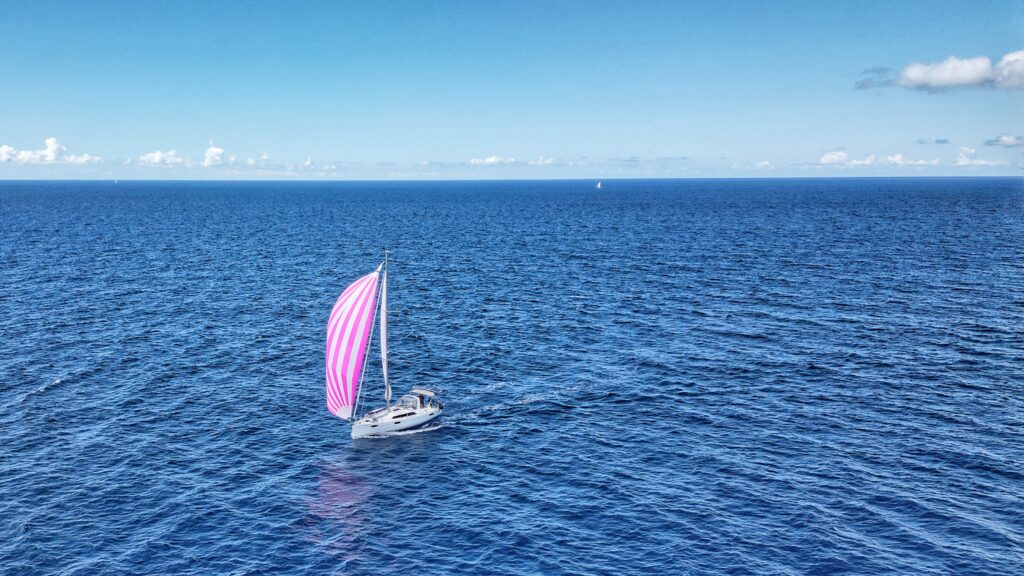
If you are ready to stop being a passenger and start building genuine offshore command confidence, join us for an intensive training week on board our cruising yacht, All Winds, in Croatia. We focus on real-world decision-making, shorthanded docking, and crew communication under the guidance of supportive professionals. With usually only 3 people to a coach on a 41-foot boat, we have time to look at the skills and troubleshooting that traditional sailing schools leave out. Weather permitting, we will fly a gennaker and give you a chance to try to do some manoeuvres single-handed as a standard part of our coaching.
For both the German and Swiss frameworks, miles must be logged on waters defined as “outside of inland waters”. The Swiss Maritime Navigation Office (SSA) explicitly accepts tidal waters, coastal sea areas where international collision regulations (ColRegs) apply, and specific large bodies of water like the IJsselmeer or Markermeer due to their challenging navigational demands. Standard cruise ship journeys or inland lake sailing do not qualify. For the RYA, 50% of the miles must be completed in Tidal Waters where published tidal information is available.
Yes. Your sea miles are valid if signed by a skipper who is legally authorised to command the vessel according to its flag state. Because countries like the UK and Ireland do not require mandatory licensing for private recreational craft under a certain size, an uncertified individual can legally act as skipper. The Swiss Maritime Navigation Office (SSA) and other organisations accept these signatures.
No. Unlike most international maritime qualifications, the Swiss certificate has absolutely no on-water practical exam. The system relies entirely on a mathematical milestone: you log up to 300 miles before your theory exam, and the remaining 700 miles afterwards. Once your logbook documentation reaches 1,000 miles and 18 days, you are issued an ocean-going license with zero independent validation of your actual physical boat-handling or docking skills.
No. Under the SSA’s Fahrtennachweis rules, self-skippered miles cannot be counted toward the certificate requirements. Even though recent Swiss maritime law updates explicitly permit you to legally skipper a Swiss-flagged yacht in coastal waters using an RYA Day Skipper or German SKS certificate, you cannot act as your own evaluator. Because the logbook requires an external skipper’s signature as a performance check, you cannot sign off on your own miles.
A basic clinic focuses strictly on isolated tasks like harbour parking, standard anchoring, and simple MOB drills. A comprehensive, real-world Skipper Training Week integrates these skills into dynamic passages. It includes continuous sail adjustments, passage planning, real-time risk assessments, pilotage in active shipping lanes, and simulated emergency scenarios—such as dealing with an unexpected engine failure while approaching an anchorage.
To develop into a well-rounded mariner, treat mileage building and command training as two separate pillars of your education. Use Mile Builders to understand continuous offshore watch systems, crew rotation shifts, and night passages. To build true skipper competence, supplement those long-distance runs with high-density training weeks that focus on real-world scenarios: active passage planning, heavy-weather reefing, dynamic sail trim, and simulated system failures.

No responses yet