
The moment you take the helm on a yacht with an inexperienced crew, your role changes. You may think of yourself as the skipper, and your training may have made a point of you being a “skipper”, but unless you are sailing with an experienced crew in a flat hierarchy, many people on board might actually need you to be their instructor. Sailing courses teach you how to deliver a safety briefing, but getting a novice crew to execute roles smoothly when putting in a reef requires much more than a two-minute speech. You have to actively—and informally—teach them the basics: loading a winch, starting the engine, steering a heading, or handling lines during a tack. With a novice crew, you effectively have to be the instructor for a “competent crew” course when your friends or family come onto the boat.
This creates an immediate clash of expectations. Nobody signed up for a training course: your friends and family signed up for a relaxing holiday, and you signed up to unwind, not to work as an instructor (and to pay for the privilege!). The challenge of the modern charter holiday is balancing this instructional responsibility in a way that keeps the mood relaxed, keeps the boat safe, and preserves everyone’s holiday. But how can we address this responsibility in a way that keeps everyone happy?

In the Swiss system, the D-Schein is a basic inland certificate of competence—roughly equivalent to an RYA Level 2 dinghy or keelboat qualification. But the route to the sea and the Hochseeschein involves passing the theory test and logging 1,000 nautical miles. You log those miles ticking boxes on someone else’s vessel, rarely sitting in the decision-making seat. The result? Many skippers head to sea without ever having to break down a manoeuvre or direct an untrained crew.
The Instructor Mindset Makes You a Better Sailor
Thinking like an instructor is a superpower for your own skills. It forces you to deconstruct every move before it happens. If you cannot explain a manoeuvre simply, you haven’t fully processed how you are going to execute it. Many failed dockings or chaotic harbour mooring attempts aren’t caused by bad helm control—the failure occurs already during the planning or briefing stage.
There is an important caveat: to break a manoeuvre down into simple steps, you need enough underlying experience to understand its component parts. This is why professional instructing bodies require pre-entry tests or demand that instructors qualify at least one level above what they teach. If you have just come off a Day Skipper course or gotten your Hochseeschein with no solo practice in between, you are quite likely still building that baseline.
When my partner Karin and I started sailing larger boats together, despite both of us having lifelong backgrounds on the water, we hit this exact hurdle. Having learned to sail around finger berths and mooring balls, I had never executed a stern-to Med moor. As we approached the quay, I realised how difficult it is to brief someone when you are still building your own mental picture. Despite having read about the manoeuvre and watched videos, executing my first stern-to moor required active processing on the fly. (You can read all about how that went in our article about Sailing together as a couple!)
Real seamanship isn’t about knowing every scenario in advance—it is about drawing on past experience to figure things out safely on the fly. We adapted my finger-berth experience to a stern-to mooring and executed it safely. But that moment reinforced a core truth: without a clear mental model, effective briefing is impossible.
How to Brief Novice Crew on Deck: The EDIC Method
Professional instructing uses the EDICT framework: Explain, Demonstrate, Instruct, Coach, Test. On a yacht, you don’t really want to “test” your crew, but the EDIC steps should be done in a relaxed way conducive to a holiday and not a shouty sailing course!
- Explain: Outline the goal before the skill is ever needed (e.g., “Before we hoist, let’s take 30 seconds to look at the winches. Heavily loaded lines can catch fingers fast, so let’s walk through how to wrap and tail them safely.”).
- Demonstrate: Show them the action physically—how to wrap a winch safely and why it is important—before you are under pressure.
- Instruct: Let them perform the task with guidance, and give clear, single-action cues during the move.
- Coach: Offer immediate, calm feedback as they execute.
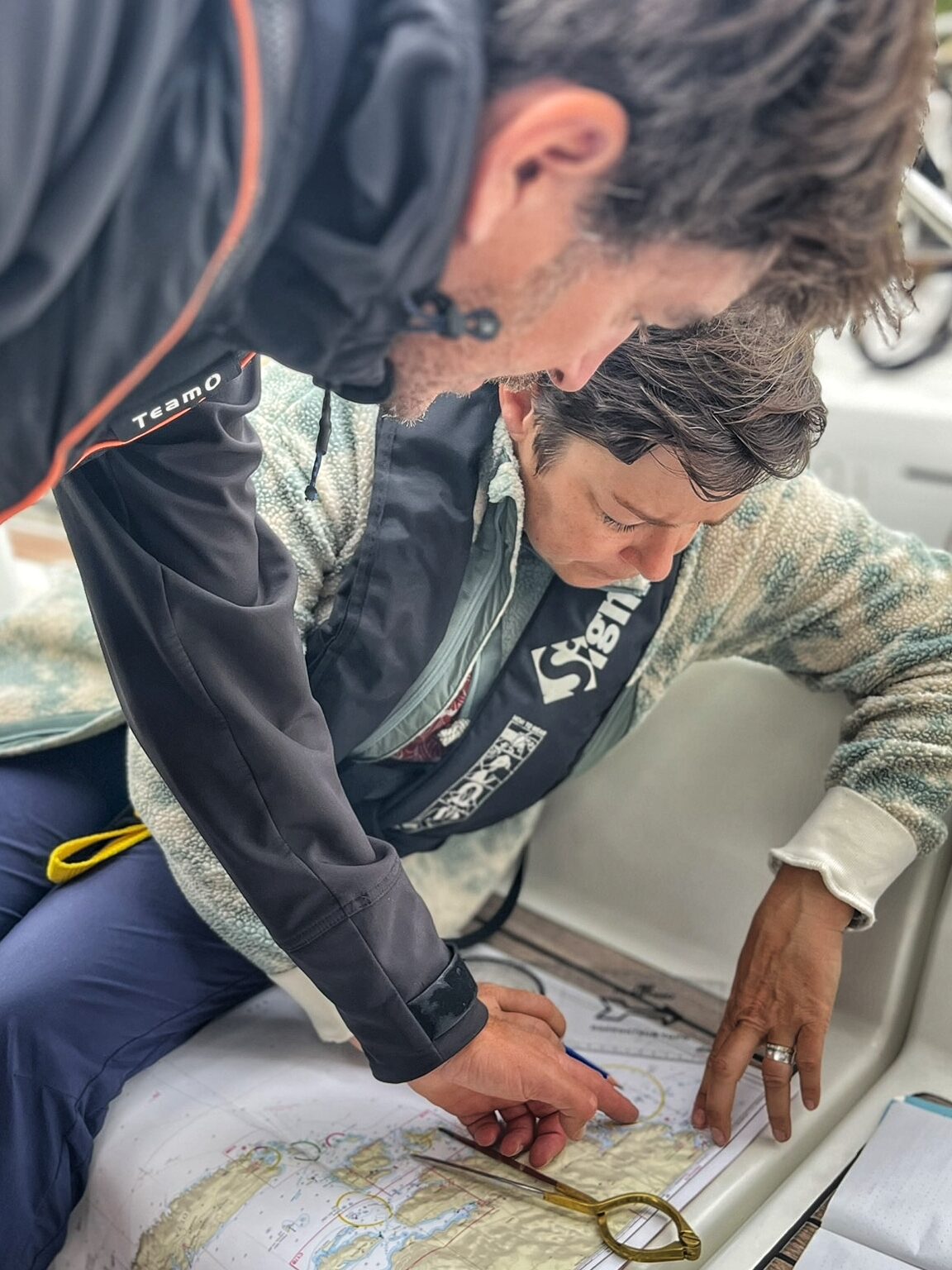
The “Single Point of Failure” Rule: Sailing with Inexperienced Guests
Before initiating any manoeuvre with a novice crew, ask yourself one simple question: What happens if my crew struggles?
Try not to depend on any plan where an inexperienced guest is your single point of failure. If your strategy relies on a beginner having to get something right first time, there is zero margin for error.
Structure your approach so that if your crew panics, mishears a command, or drops a line, the boat remains in a safe, neutral position. Design the move so their assistance makes things smoother, but their mistakes won’t cause a crisis. Giving yourself that extra cushion removes the pressure for everyone on board.
The Safety Paradox: 3 Tasks Your Crew Must Know if You Fall Overboard
Reluctance to coach your crew creates a genuine hazard. New skippers often avoid teaching partners or friends out of fear of appearing bossy or inexperienced; this is exaggerated when sailing with a less experienced partner or with friends or family on a holiday.
Consider the paradox: if you do not teach your crew how to start the engine, drop the anchor, or operate the VHF radio, you leave yourself entirely unprotected if you fall overboard or become incapacitated. Teaching basic boat handling isn’t micromanagement—it is your primary safety net.
This risk was highlighted by two tragic real-world incidents. In Croatia, a skipper on a charter holiday fell overboard; his novice crew did not know how to stop or turn the yacht to recover him, and he was lost. In another case off Italy, a man fell overboard while sailing with his partner; unable to operate the electronics or radio, she drifted for three days before coming back into coastal mobile coverage to call for help. Spending 10 minutes showing your crew how to hit the MOB button on the plotter, start the engine, and fire off a DSC distress call is an essential safety step.
Protecting Your Bandwidth: The Go / No-Go Matrix
There is a massive difference between expanding your experience and putting your crew in harm’s way. Nobody learns when they are terrified—least of all a skipper who is trying to figure out a manoeuvre while managing a stressed-out crew.
To teach calmly and execute manoeuvres safely, you need mental bandwidth. That bandwidth vanishes the moment weather conditions exceed your crew’s ability. Setting clear operational limits on the pontoon before casting off ensures you stay well within your comfort zone.
To take the guesswork out of this evaluation, we integrated the Go / No-Go Decision Matrix directly into our digital All Winds Toolbox app. By rating forecast wind strength, sea state, crew experience, and destination risk before leaving the berth, the app gives you an objective risk assessment. It ensures you preserve your mental bandwidth, allowing you to draw on your personal seamanship toolbox and coach your crew with confidence.

Conclusion: Becoming the Skipper Your Crew Needs
Stepping into the role of skipper doesn’t mean you have to act like a stern academy instructor. It means taking responsibility for the environment on deck. By taking a few minutes to explain mechanics calmly, demonstrating key tasks before leaving the berth, and setting clear boundaries before setting sail, you create a safe space where your crew feels capable and relaxed.
Bridging the gap between holding a qualification and feeling completely confident in command is a journey every skipper takes. If you want to refine your boat handling, practise shorthanded routines, or build confidence leading your crew, explore our hands-on skipper coaching and charter preparation courses.
Where Are You Taking Your Seamanship Next?
Whether you are bridging the gap from license to real confidence, chartering your next holiday, or sailing locally in Switzerland, choose the pathway that matches your plans.
Build Real Seamanship & Confidence
Ditch empty mile-building and crowded bunks. Join Head Coach Dave aboard our Beneteau Oceanis 41.1 in Croatia. Maximum 3 guest cabins, private accommodation, and dedicated coaching grounded in sports biomechanics.
Charter With Mechanical Sympathy
Charter All Winds directly from Marina Frapa, or let our independent agency source and vet quality bareboat yachts worldwide. We handle the technical vetting so you avoid tired charter fleets and deposit traps.
Join Us in Switzerland
Step aboard on Lake Zug for after-work social sails, join a windsurfing clinic, or attend our online workshops covering boat-handling dynamics, weather app interpretation, Swiss D-Schein exam strategy and much more.
Keep it conversational and focus on the “why” rather than barking commands. Frame briefings around comfort and safety—for instance, “Let me show you a quick 30-second trick on the winch so no one pinches a finger today”—rather than treating deck prep like a formal drill.
At a minimum, show every crew member how to press the MOB mark button on the chartplotter, start and stop the engine, put the throttle in neutral, and send a DSC distress alert on the VHF. These basic steps ensure your crew can react if you fall overboard or become incapacitated.
Take over the active role calmly without raising your voice. Reassign them to a zero-pressure task—like sitting safely in the cockpit or holding a fender—and complete the manoeuvre yourself. Once the boat is secure, walk through what happened in a relaxed way.
Mental rehearsals away from the boat are a great start, but sailing smaller boats—like dinghies or small keelboats—is where you learn mechanics deeply. Small boats give immediate physical feedback: you feel sail pressure, helm balance, and wind drift without the distraction of heavy winches or engines. That deep mechanical understanding makes it much easier to break down and explain manoeuvres on larger cruising yachts.
Apply the Singlehanded Backup Rule: ask yourself if you could complete or abort the manoeuvre singlehandedly if your crew freezes or drops a line. If a manoeuvre relies 100% on a beginner executing a high-pressure task perfectly, rethink the setup. Structure the move so your crew supports you, but you maintain ultimate control if things go sideways.



No responses yet