
Mention sailing to anyone in Central Europe, and the conversation almost immediately turns to certificates. In Switzerland, adults entering the sport are pushed straight toward the D-Schein—a legally mandated license for boats with more than 15m² of sail area. Across the border in Germany, while pure sailing is largely license-free on federal waterways unless you run a motor over 15 HP, specific bodies of water (such as Lake Constance with the Bodenseeschifferpatent or certain Berlin lakes) require dedicated local licenses.
Despite these regional nuances, the cultural mindset across the entire DACH region (Germany, Austria, Switzerland) remains almost identical: the ability to sail is closely linked to some sort of formal certification. (not just education!)
From Day 1, students are put under exam pressure: memorising rigid manoeuvre recipes, cramming local lake regulations, and stressing over a single exam. Proponents often argue that a sailing license is “just like a driving license”—a necessary benchmark for public safety. But that comparison only goes so far. Yes, the maritime world has its version of road signs (navigation marks), traffic control (VTS), and roadside assistance (like the RNLI or DGzRS). But that is exactly where the similarity ends.
A paved street is a static, constant environment. The sea is a living, moving entity with its own shifting personality; it is almost impossible (and in our opinion dangerous) to force rigid, black-and-white rules onto a fluid environment. Furthermore, the speeds we are dealing with on a sailboat are a fraction of what you experience on a motorway or Autobahn.
Taking a boat to sea isn’t like driving on a paved road—it’s like off-road expedition driving. Off-road, a standard driver’s license is practically irrelevant; safety depends on reading terrain, hands-on skill, and self-reliance. A licensed street driver might be completely useless off-road (and in many remote places, off-road driving doesn’t even legally require a license). A paper sailing certificate simply proves you passed a test under controlled conditions; it does not prove you can evaluate an approaching frontal system, set an anchor when it counts, or manage a nervous crew when the wind suddenly doubles, and the reef has to be set quickly.
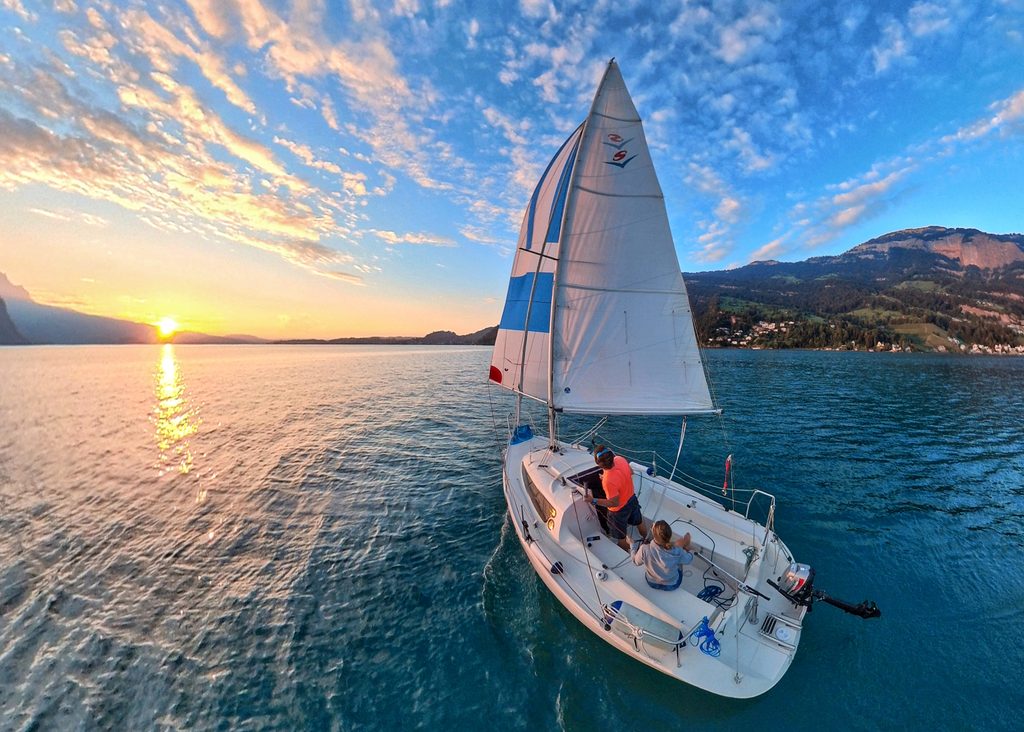
The deepest flaw in exam culture isn’t just that it forces you to memorise theory—it’s that it flattens complex, real-world seamanship into black-and-white rules, actively penalising individual judgment.
Take an actual question directly from the official Swiss theory exam for the Binnenschein Kat. A & D:
Question: “Was haben Sie als Schiffsführer zu veranlassen, wenn ‘Sturmwarnung’ angezeigt wird?” (What are you required to do as skipper when a ‘Storm Warning’ is displayed?)
If you select the answer option: “Die Wetterentwicklung selbst beobachten und sich entsprechend verhalten” (Observe the weather development yourself and act accordingly)—the exam marks you wrong.
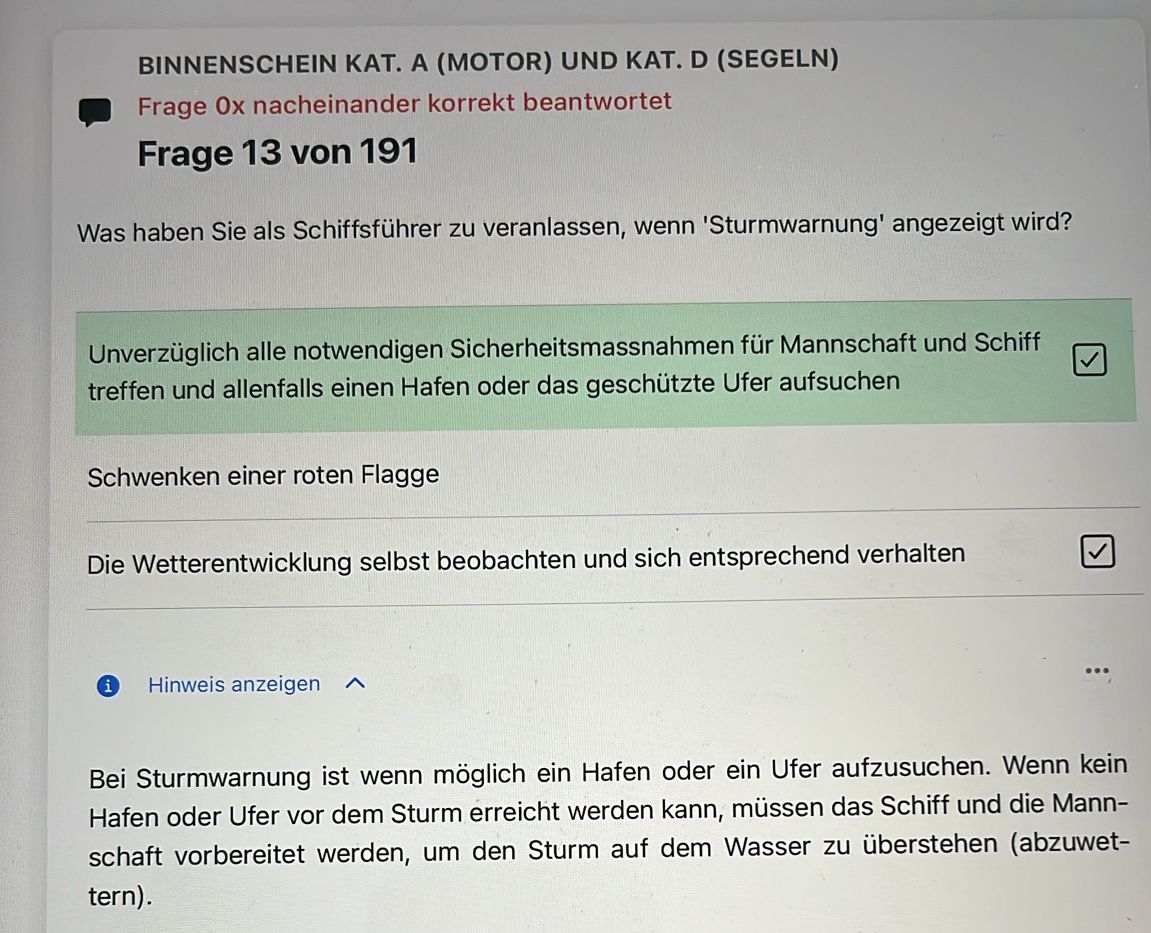
Think about what that teaches a student: evaluating the situation yourself is officially an incorrect response. Proponents argue beginners need rigid rules—and they have a point. When you have zero experience, a simple recipe keeps you out of trouble.
The flaw is the single-ticket trap. In a one-and-done exam culture, that beginner recipe becomes the permanent ceiling of a sailor’s education. Progressive training starts you with a simple formula—like learning a Figure-of-8 MOB—and gradually stacks nuance onto your decision-making as your skills grow.
Treating a beginner multiple-choice test as the final authority traps sailors in beginner-level thinking forever—swapping adaptable seamanship for a rigid script.
The exam system demands an immediate, rigid procedural reaction (head for port or prepare the boat) and penalises the skipper for choosing to observe the sky and assess the conditions. Yet, real seamanship is built entirely on continuous weather observation, spatial awareness, and adaptable decision-making. When a multiple-choice app conditions sailors to believe that watching the weather and using personal judgment is wrong, it isn’t teaching safety—it is training people to turn off their brains.
The “5 Essentials” vs. The Exam Factory
I grew up sailing in Ireland, where pleasure craft under 24m require no state license. The UK, France, and the Netherlands take a similar approach: if you want to go sailing, you simply go sailing. Education and courses abound, but there is no state-mandated exam for private leisure use.
In these coastal countries, for many the standard path starts in small, open dinghies—boats like Laser Bahias, RS Vagos, Toppers, or Lasers (ILCA to the younger readers!). In these small craft, there is no engine, no cabin, and often no instructor sitting in the boat with you from Day 1, even on an introductory course. You are handed the tiller, shoved off the beach, and forced to learn through direct, immediate physical feedback using the 5 Essentials of Boat Handling:
- Course (Heading relative to the wind)
- Sail Trim (Power management)
- Boat Balance (Using body weight to keep the hull flat)
- Boat Trim (Fore and aft weight distribution)
- Daggerboard Position (Managing leeway)
In an open dinghy, if you get these wrong, you don’t just slow down—you capsize and swim. That immediate physical feedback builds an intuitive understanding of wind physics, balance, and sail power that stays with you for life.
More importantly, certification in this environment is a personal milestone, not a legal gatekeeper. You might pick up an RYA or ISA level along the way, but no one asks for a license before letting you sail privately. In fact, external examiners do not enter the picture until you reach advanced, commercially endorsable qualifications like the Yachtmaster or Powerboat Advanced CoC.
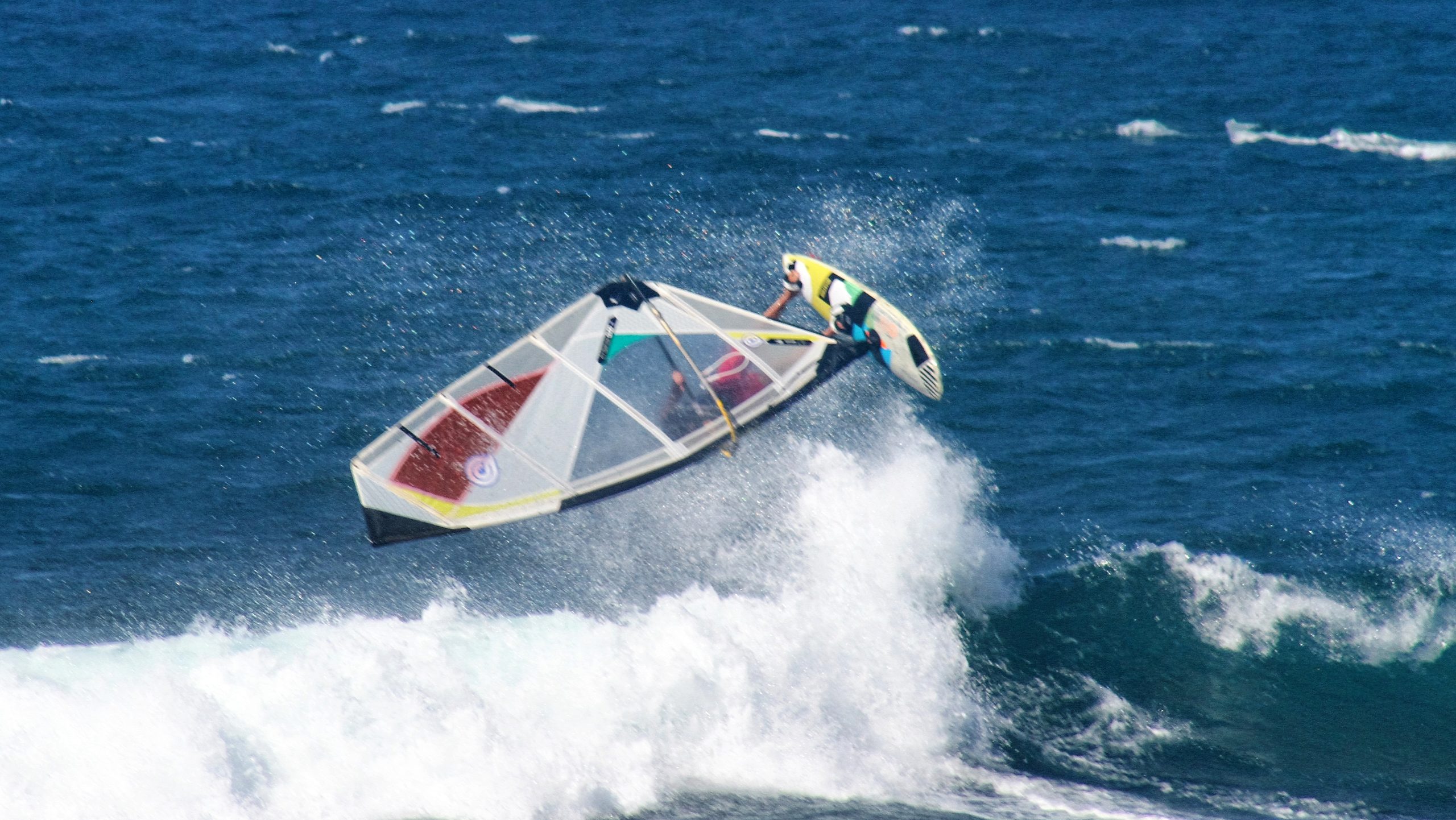
My own path was completely backwards by DACH standards. I had spent years windsurfing, jumped into sailing dinghies whenever they were around at the windsurfing centre, and was eventually offered the chance to take a Sailing Instructor qualification. The very first formal sailing course I ever took in my life was my Sailing Instructor Course—and I was only 15 or 16 years old!
Windsurfing had already taught me sail power, balance, and wind awareness. When we took our instructor pre-entry test—which is functionally similar to a practical D-Schein exam, but conducted in real wind on boats that capsize—we had to execute every manoeuvre cleanly to demonstration standard. Then, to prove we had the 5 Essentials 100% mastered, we had to do the entire test all over again rudderless, steering the boat purely through sail trim and crew weight distribution.
Small side note: I was once even asked for a license to rent windsurfing equipment in Switzerland!
The “Hochseeschein” Paradox
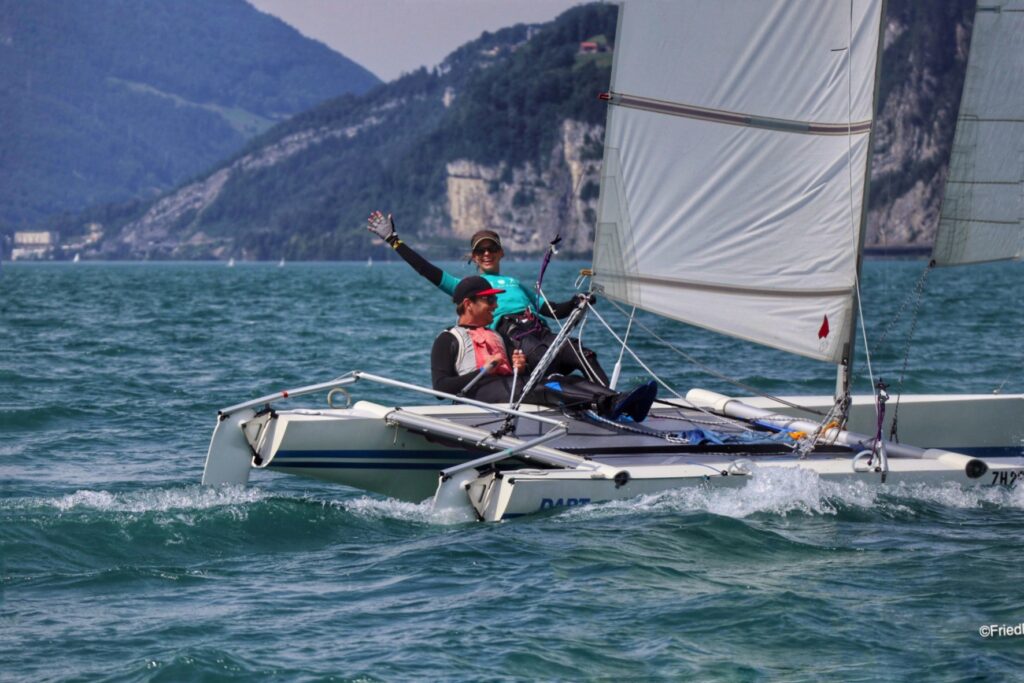
When I first moved to Switzerland, I spent a few years windsurfing and looking for opportunities to get onto the water. Sailing locally really took off when I met Karin. I had previously managed a watersports centre on the beach in Hawaii, where I sailed Hobie 16 catamarans, so when Karin introduced me to her Dart 18 Catamaran, it wasn’t my first time on a fast cat—but it was a fantastic chance to get back out on the water in Switzerland after a long break.
To legally sail larger keelboats on Swiss lakes, I did what everyone does: I completed the Swiss D-Schein (and A-Schein for motorboats).
Shortly after, when we began planning a charter holiday on the sea, I remember being asked by local sailing friends: “Aber du bruchst ein Hochseeschein für das!” (“But you need an offshore license for that!”).
I couldn’t process the concept. To me, sailing was the sea. I had learned on the ocean, taught on the ocean, and held advanced qualifications. Yet here on a quiet Swiss lake, people were telling me I wasn’t allowed to sail on the sea without a lake-derived paper certificate. (In reality, I held an ICC based on my prior qualifications).
This highlights a major misunderstanding about how chartering actually works globally:
- In the Mediterranean (Croatia, Greece, Spain): Charter companies will ask to see a recognised license card (SBF See, ICC, Day Skipper, etc.). But let’s be honest about why: they need it to satisfy local port authorities and protect their fleet insurance, not because the piece of paper makes you a competent skipper.
- In Atlantic France and the Caribbean: Charter bases care far more about your sailing resume. They will ask: Where have you sailed? What size boat have you skippered? What conditions have you handled? A paper license with zero active command hours won’t impress them—logged, real-world experience will.
Education vs. Credentialism: Why Real Training Matters
To be 100% clear: we are not advocating against sailing education. Learning meteorology, navigation, collision regulations, and boat mechanics is essential. Good coaching builds skills in a guided environment, while solo experience forces you to make decisions without a safety net. Both are vital.
What we are challenging is credentialism—the false belief that collecting stackable paper certificates equals seamanship, or that you must hold an advanced offshore license before you are “allowed” to gain real sea experience.
Does “No License” Mean More Accidents & Rescues?
There is a persistent myth in heavily regulated countries that operating without a mandatory state license is “dangerous” and places an unfair burden on sea rescue services.
A debate on a social media post after a German television programme interviewed two young sailors who finished their circumnavigation (having started with only the most basic motorboat qualification) recently highlighted this exact reflex, with critics claiming that sailors operating on basic credentials put rescue crews at risk. My response to that debate cuts to the heart of real seamanship:
“No license in the world gifts you safety at sea—safety comes from experience, respect for the weather, and genuine seamanship. Experience must be earned on the water. If you start a circumnavigation from Northern Europe, you must navigate the North Sea, the English Channel, and the Bay of Biscay. Mastering these challenging tidal waters builds far more real competence than memorising multiple-choice exam questions.
In major sailing nations like the UK, the Netherlands, Ireland, or France, there is no statutory license requirement for private sports shipping. People still learn to sail, but the training systems (like the RYA) are designed to build real operational competence and seamanship rather than testing minimum exam standards. Responsibility is not shown by a piece of paper in a cupboard—it is shown in your willingness to learn, your humility before the elements, and your real ability on deck.”
Look at France, where offshore sailing is deeply rooted in the culture, and no government license is required to sail a private leisure boat with an auxiliary motor. France produces some of the finest sailors on the planet. Yet, even at the absolute elite level, rescue interventions happen.
As an Irish sailing fan, it was heartbreaking to watch Irish skipper Tom Dolan—winner of the 2024 Solitaire du Figaro and one of the world’s most accomplished solo offshore sailors—get forced out of Leg 3 of the 2026 Solitaire du Figaro. While leading, his boat ran aground on the treacherous Chaussée de Sein off Brittany, requiring a Navy helicopter airlift in heavy swell. Extreme weather damage, groundings, dismastings, and airlifts happen regularly to world-class, professional sailors pushing the limits of the sport.
Maritime emergencies are driven by structural failures, rapid tactical shifts, and raw ocean power—not by whether a leisure sailor holds a laminated government card.
The claim that uncertified leisure sailors cause a flood of avoidable rescues is completely disproven by search-and-rescue data across Europe:
- What Rescue Services Actually Do: Official annual statistics from the RNLI (UK and Ireland) show that out of more than 9,000 lifeboat launches a year, sailing yachts account for less than 8% of total launches. Callouts are overwhelmingly for beachgoers, paddleboarders, people on inflatable toy boats blown offshore by wind, walkers cut off by tides, or routine mechanical failures on motorboats.
- Why Yachts Call for Help: When sailing yachts do require assistance—whether in non-licensed countries like France and the UK, or licensed countries like Germany (via the DGzRS)—it is almost always due to sudden engine failure, steering breakdown, net entanglements, or severe weather damage. These issues affect highly qualified, professional crews just as easily as novices. Per capita and per kilometre of coastline, uncertified sailors in France or the UK do not produce higher rescue rates than certified sailors in Germany.
In fact, there is an argument to the contrary: that mandatory certification can create a false sense of security, leading newly licensed skippers to believe they “know it all” after passing an exam, potentially taking risks they are not yet equipped to manage.
The Big Misconception: “Right of Way” Does Not Exist at Sea
Where inland lake sailors frequently struggle online and on the water is not the mechanics of sailing—it is the rules.
If you browse online sailing forums, you will constantly see inland (or regatta) sailors arguing about who has “Right of Way” (Vorfahrtsrecht). But here is a critical fact that every seaman should know: “Right of Way” does not exist in the International Regulations for Preventing Collisions at Sea (COLREGs).
The word “Right” implies an entitlement. Under COLREGs (Rules 12, 13, 15, and 18), the law only defines Give-way (Ausweichpflicht) and Stand-on (Kurshalter) duties:
- The Give-Way Vessel: Required to take early, substantial action to keep well clear.
- The Stand-On Vessel: Required to maintain her course and speed so the give-way vessel can predict her movement. (You are still required to change course to avoid a collision if the give-way vessel does not alter course, but you should give them time and be predictable so that they can change course)
On inland lakes in Switzerland and Germany, regulations (Binnenschifffahrtsverordnung) give blanket priority to commercial passenger ferries over pleasure craft. Lake sailors are conditioned to panic and get out of the way of any ferry immediately.
At sea, however, assuming a ferry or cargo vessel automatically has priority based on lake rules can be fatal. As we analysed in our breakdown of the Splitska Vrata Ferry Collision, if a pleasure craft makes an unpredictable, panic-induced course alteration in front of a commercial vessel because they assume “the ferry always has priority,” they break COLREGs, confuse the commercial bridge team, and create a high-risk collision sequence.
Ocean First: You Don’t Need a Lake License to Start
You do not need to spend years on an inland lake or collect stackable paper certificates before you are “allowed” to go ocean sailing. You can learn to sail directly on the sea from Day 1.
In fact, in many ways, sea sailing is simpler than lake sailing:
- Consistent Winds: Ocean thermals and gradient winds are far smoother and more predictable than the violent, 90-degree katabatic shifts off mountain cliffs.
- Sea Room: On a lake, safety usually means getting to shore quickly. At sea, safety means staying away from the lee shore and using your open sea room to think and prepare.
- Tides Are Just Math: Tides are not black magic—they are predictable timing and simple vector arithmetic.
Shifting from Tests to Seamanship
If you learned to sail on an inland lake, don’t let administrative jargon intimidate you. Focus on moving from passing tests to building real sailing experience:
- Get Active Helm Hours: Take the helm on local waters (via boat-sharing like Sailbox or local social sails) without an instructor hovering over your shoulder.
- Master Boat Feel: Focus on the 5 Essentials—hull heel, sail pressure, and balance—rather than staring at electronic displays.
- Recognise Your License as a Learner’s Permit: Take a model like the RYA Day Skipper: it isn’t a high-stress, single-day exam factory. It relies on continuous, direct assessment over an entire week on the water with an instructor, removing exam panic and ending with a progressive debrief regardless of the outcome. It gives you the minimum safe skills required to go out and start earning real-world experience. Passing the course is explicitly framed as the beginning of your learning journey, not the finish line. Mandatory exam cultures frame things completely backwards by treating a paper certificate as the ultimate proof of mastery.
- Bridge the Gap on a Guided Coaching Trip: If you want to transition to open water, join an active Skipper Coaching Week in Croatia where an experienced coach handles ultimate liability while you take full command of the yacht, docking, and passage planning.
At the end of the day, water is water and wind is wind—and we need to stop putting bureaucratic and cultural obstacles in the way of people who want to learn.
Too often, an “old guard” of box-tickers—boasting about a certificate earned in 1982 as if it renders them invincible—makes entry into this sport unnecessarily intimidating. But every sailor started at Day 1, and real seamanship means admitting we learn something new on every passage. (In fact, be very wary of any skipper who claims they know it all!)
Instead of gatekeeping with paper cards and exam fear, we should be encouraging those new to the sport, building their real confidence on the water, and supporting them as they step off the lake and head to sea.
It depends on the region. In the Mediterranean (Croatia, Greece, Spain), charter bases and port authorities legally require a recognised certificate (such as an ICC, SBF See, or Day Skipper) for insurance and legal compliance. In Atlantic France or the Caribbean, charter bases focus heavily on your sailing resume, evaluating your active command hours, vessel size history, and real-world experience rather than paper credentials alone. It never hurts if at least one person on the boat has a basic certificate.
Not necessarily—in many ways, sea sailing can be simpler than mountain lake sailing. Ocean winds and thermals are generally smoother and more predictable than erratic mountain gusts, and open sea room gives skippers more time to prepare and execute manoeuvres. The primary adjustment for lake sailors involves mastering international COLREGs, coastal weather, and anchoring scope rather than the core physics of sailing.
The term “Right of Way” (Vorfahrtsrecht) does not exist in international maritime law (COLREGs). Instead, the rules strictly define Give-way (Ausweichpflicht) and Stand-on (Kurshalter) duties. A stand-on vessel is required to maintain course and speed, while a give-way vessel must take early, substantial action to stay clear. Assuming a commercial ferry automatically has priority at sea based on inland lake rules can create dangerous collision hazards.

No responses yet