
The coastline of Montenegro presents a noticeable change in geography. Leaving the low-lying shores of northern Albania or crossing the Adriatic from Italy, you are met by limestone mountains dropping directly into relatively deep water.
While Montenegro has developed a lot of infrastructure recently—anchored by large developments like Porto Montenegro—it represents a minor challenge from a bureaucratic perspective. There is good infrastructure here compared to Albania, but the costs are higher, and you get the feeling that the local developments prefer superyachts to standard cruisers.
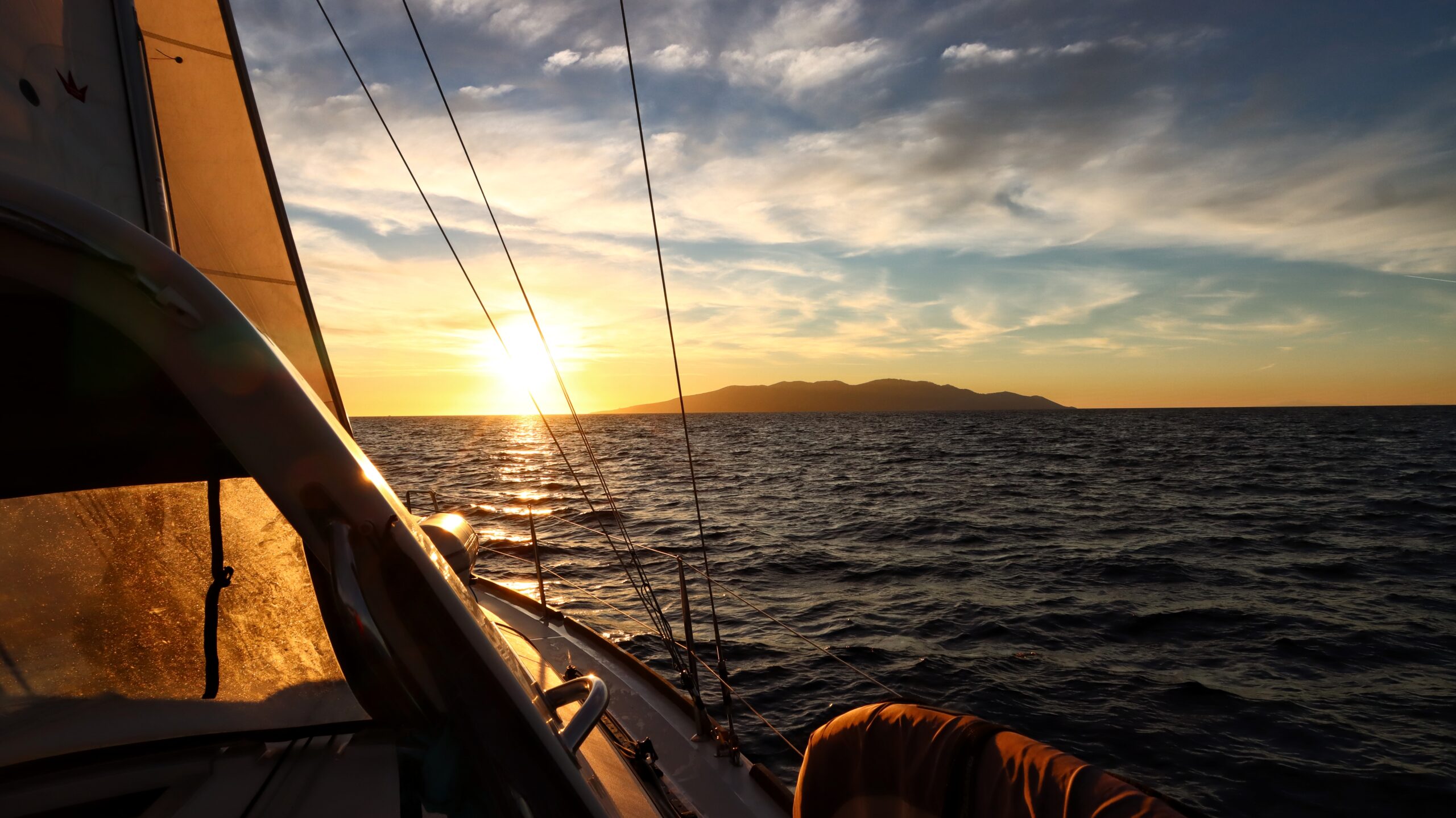
We sailed from Durrës to the southern port of Bar overnight. To minimise the risk of being caught in thunderstorm cells tracking across the coast, we adjusted our route and timing to stay further offshore than the direct route, avoiding the storm activity building in the Bay of Shëngjin. Our passage planning for this leg relied on a daily check of Windy forecasts, community reviews on Navily, and the route outlines in our copy of the Imray Adriatic Pilot.
The Clearing Process: Checking In at Bar
When arriving from the south, the industrial port of Bar is the most practical official Port of Entry. The clearance process does not legally require a maritime agent, but it must follow a specific order between the customs quay, the Harbour Master, and the Border Police.
In Montenegro, it is important to check in before doing anything else, such as refuelling or heading around to the marina. The text on the border control window also specifically notes that when checking out, you must leave the country’s territorial waters by the most direct route. (i.e. don’t refuel or anchor in a bay after checking out!)
When entering the commercial port, no one answered our calls on VHF Channel 16 or the working channels, so we simply went into the basin and onto the wall ourselves.
The Bar Customs Quay
Various reports on Navily warn of iron bars sticking out of the concrete customs dock in Bar. In our experience, while there was certainly exposed iron on the concrete pier, nothing was protruding out in a way that was likely to cause a well-fendered boat any damage. The protection inside the harbour is actually quite good from most directions, and managing the alongside manoeuvre was straightforward:
- Fendering: We deployed our wooden gangplank horizontally over the fenders to act as a solid fender board, ensuring greater protection for the hull against the rough concrete wall.
- Line Handling: We used a stern line to spring onto the quay. This allowed us to go astern towards a large bollard, lasso it, and then go ahead on the engine to spring on. This held the boat steady and gave us time to go ashore and secure a ring for the bow line. It was an entirely uneventful arrival—just basic seamanship.
The Paperwork Sequence
From the customs quay, the Harbour Master’s office is a brief two-minute walk. This is your first shoreside stop to buy your vignette and present your ship’s papers, skipper’s licence, and valid third-party insurance.
Interestingly, the officials were more familiar with and seemed to prefer an International Certificate of Competence (ICC) over a commercially endorsed Yachtmaster certificate, which took some time to verify. Once approved, you pay for your Vignette (the mandatory cruising permit, scaled by boat length and stay duration) and the standard tourist tax.
With the Vignette stamped, you take the paperwork to the Border Police office at the port terminal to complete passport control before moving the boat around into the marina.
Staying in Bar
Bar itself is pleasant, but it has no specific town centre unless you take a bus or taxi to Stari Bar. There is also a steady stream of cruise ships, making the waterfront area quite full of tourists. We still found it a pleasant place to walk around, and it is a good location for provisioning; several large supermarkets are within easy walking distance of the marina, allowing you to stock up without having to pay marked-up marina prices.
During our stay in the marina at Bar, the weather models began showing classic warning signs: a steady increase in the CAPE index, a heavy, thundery feeling on the ground, and signs of a convective front travelling across the Adriatic. Believing the risk was real, we chose to stay put for an extra night in the safety of the marina.
Other crews decided to push on. We later learned that some of the boats that left ended up caught in the front in Bigova. The winds were severe enough that vessels dragged the local mooring buoys, forcing the crews to drop the moorings entirely and attempt to re-anchor in the middle of the storm.
Along the Coast: A Night in Bigova
Once the front passed, we pushed northwest from Bar toward the entrance of the Bay of Kotor, passing Budva (which we would like to visit next time) and anchoring for a night at the small fishing village of Bigova.
In contrast to the chaotic night the previous crews had experienced during the storm, we arrived in calm conditions. We managed to get our anchor to set cleanly and securely on the first attempt, enjoying a completely peaceful night’s sleep. It is a scenic, traditional anchorage and an ideal staging point before tackling the entrance to Boka Bay.
Inside Boka Bay: Winds and Superyachts
Sailing into the Bay of Kotor (Boka Bay) was a memorable part of the trip. The wind was light, and we glided in under gennaker past the old defences at the mouth of the bay.
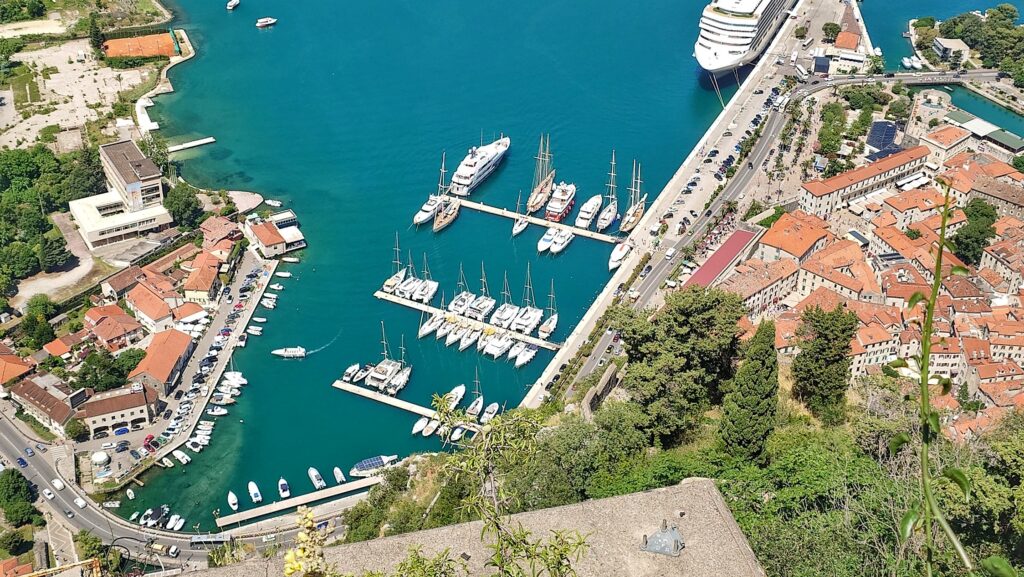
However, the modern nautical reality of the Boka presents a distinct contrast. Having followed the area’s promotion as a key venue for high-performance sailing events like the Ocean Race Europe, we were disappointed by the lack of sailboats under canvas. The inner waters are overwhelmingly dominated by massive luxury motor yachts and tourist RIBs.
The Sailboat Support Gap
This commercial focus on the superyacht industry has created a practical challenge for cruising sailboats: we found no chandleries with a good selection of sailboat products in Tivat or Kotor specifically. We needed to replace our main halyard during the trip and were completely unable to source running rigging locally. While we cannot speak for the entire Boka—who knows what marine services might be available within the newer Portonovi development—don’t expect to be able to walk into a chandlery and get whatever you need for your boat like in Lefkas, Greece or other nautical hotspots.
Winds Inside the Bay
While textbooks often warn of extreme venturi winds in the narrow Verige Strait (the 340-metre wide pass connecting the outer and inner bays), we had an enjoyable sail both ways. Instead, the most notable feature was just how drastically the wind direction shifts within the different basins of the fjord.
We happily sailed wing-on-wing straight down the Verige Strait towards Kotor and pleasantly tacked our way back out two days later. We were one of the few boats transiting the straits under sail. It is a rewarding experience, but it is something you want to time carefully when no cruise ships are moving through the pass, and you need to be completely confident in your boat handling.
Navigational Note: The local ferries in the middle of the strait have priority; sailing boats must ensure they do not impede their transit.
Exploring Kotor
Reaching the absolute end of the fjord brings you to the historic town of Kotor. The local marina is very pleasant and places you directly at the gates of the medieval old town, though crews should note that the marina facilities are basic—there are currently no toilets or showers available at the town berths.
When we arrived, the local marinero was incredibly helpful, pointing out so many things to do in the area that we immediately extended our stay by an extra day. If we visit again, we will stay even longer.
- The Fortress Hike: The steep walk up the ancient stone fortifications directly behind the town offers clear views over the bay and the old town of Kotor itself.
- The Cable Car: A short bus ride from the town centre takes you to a modern cable car system. This lifts you up to 1,200 metres, providing a view over the whole Boka Bay and the sea outside.
Sveti Marko Island to Porto Montenegro
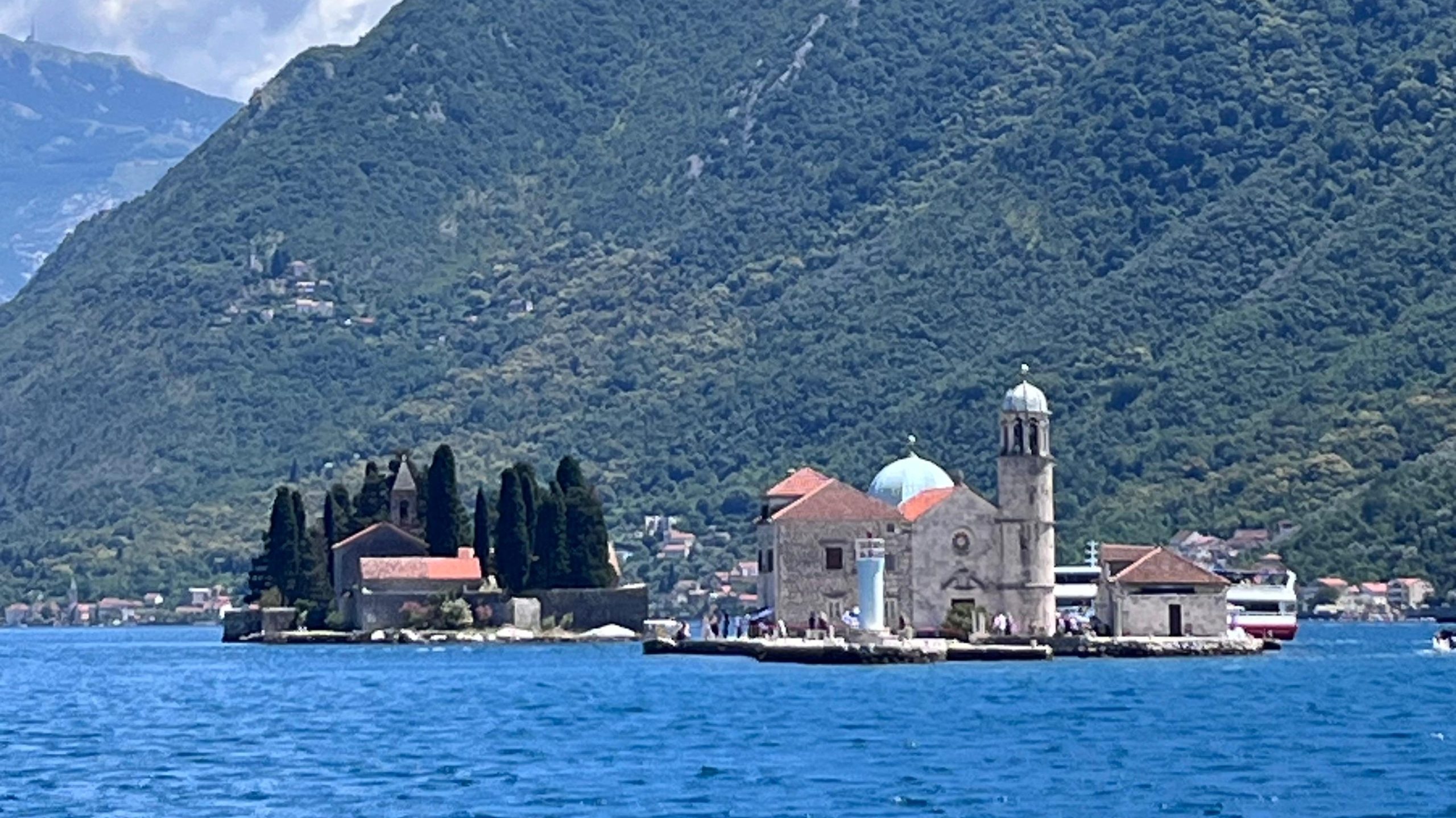
After leaving Kotor, we sailed past Perast and the little islands before transiting the strait again and spending a night off the island of Sveti Marko.
During the afternoon and evening, there were a large number of motorboats and superyachts around, but they thinned out as the sun set. We enjoyed a sunset swim and a quiet night at anchor before heading to Tivat the next morning.
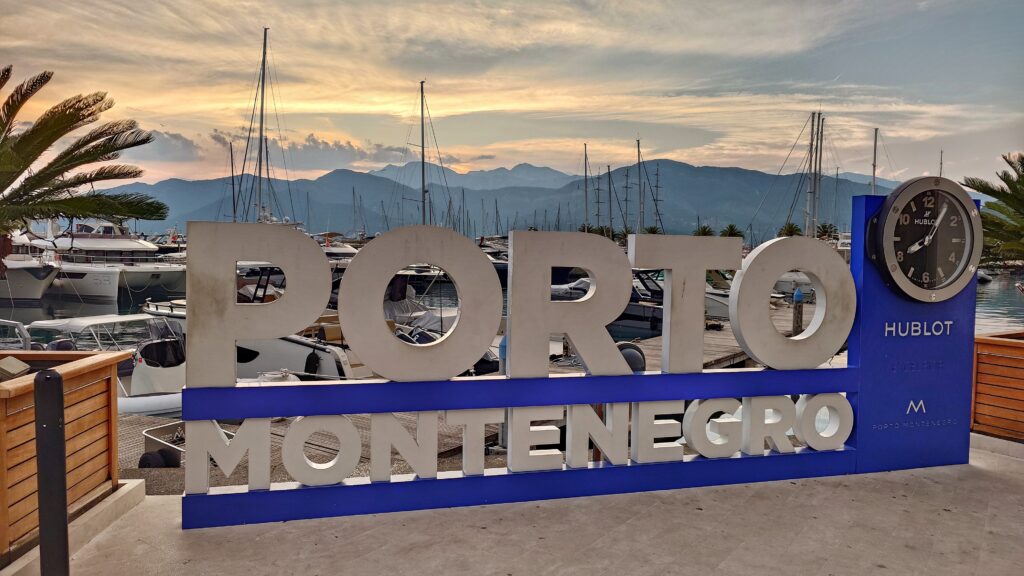
Porto Montenegro was really a case of seeing how the other half lives. Sailing All Winds into the marina under the shadow of the 106-metre (350-foot) sailing yacht Black Pearl felt like crossing the threshold from a normal cruising reality to the world of the super-rich. It is clear that Porto Montenegro caters much more to superyachts than standard sailors, which makes me wonder why they sponsor sailing events like the Ocean Race Europe. The marina itself, the shops, and the restaurants are quite expensive, and while the scale is notable, for us it was not so inviting.
Leaving Montenegro: The Porto Montenegro Q-Dock
When it comes time to clear customs and exit the country, your choice of departure quay matters. We spent our final night in the marina of Porto Montenegro in Tivat. This made the administrative side much easier, as the marina staff provided a golf cart to take us on the long walk to the Harbour Master’s office. Without this assistance, navigating the paperwork layout on foot is a challenge.
However, from a pure handling perspective, the dedicated Customs Quay (Q-Dock) at Porto Montenegro is significantly more difficult to manage than the commercial wall in Bar:
- High Vertical Face: The quay wall is built quite high out of the water. For a standard 40-foot cruising yacht shorthanded, it is difficult to toss lines up or lasso the massive, elevated dock bollards from a low deck.
- The Climb: Scaling the wall to secure your lines or go ashore is not easy, and if you go alongside a structural steel ladder, you risk damaging your hull. Furthermore, the quay is often congested with a high volume of large vessels moving in and out of a confined space.
- Alternative Options: It may be worth investigating the customs facilities at Portonovi Marina further down the channel for future trips, as its lower pontoon infrastructure is far better suited to standard cruising hulls.
Once checked out, you are legally required to take the most direct way out of Montenegrin waters. For us, this meant heading towards Cavtat in Croatia to get All Winds and our crew back toward our standard schedules.
Passage Planning Quick-Reference Notes
If you are mapping out your route along the Montenegrin coast, these are the key takeaways from our logbook:
- Bar to Budva (The Open Coast): Entirely exposed coastal water sitting right below high mountain terrain with minimal natural shelter. Keep a sensible offshore margin, monitor Windy for sudden shifts in the CAPE index, and if the air feels heavily thundery, secure a berth inside the marina at Bar early.
- The Outer Boka (Entrance Basin): A wide, semi-enclosed deep water basin. It handles a heavy volume of fast tourist RIBs and superyachts but offers virtually no technical support for sailboats. Carry your own inventory of spare lines and rigging hardware.
- The Verige Strait (The Compression Pass): The narrow channel connecting the outer and inner bays. The wind direction is highly variable and can shift drastically between basins. Watch for the local car ferries—they have priority. Time your transit to avoid commercial cruise ships and ensure you are confident in your boat handling.
- The Inner Kotor Basin (The Landlocked Fjord): A completely landlocked basin surrounded by sheer cliffs. The drop-offs near the shore are steep, and town quay facilities are basic (no showers or toilets). Plan for a multi-day stay to hike the fortress walls and take the 1,200-metre cable car.
Explore the Elements with All Winds Adventures
Cruising through the transitions of Montenegro tests a skipper’s ability to read local wind variations and manage precise port logistics. Building these foundational skills is what turns an anxious holiday into an empowering command.
- Charter All Winds Directly: Our beautifully prepared Beneteau Oceanis 41.1 is available for private charter bookings directly from our base in Croatia.
- Worldwide Charter Brokerage: Looking to explore other waters across the Ionian, Adriatic, or Tyrrhenian seas? As an independent charter agency, we source and vet quality fleets worldwide, managing all background logistics for you.
- Sailing & Windsurfing Coaching: Want to master heavy-weather sail trim, analyse complex local wind compression zones, or perfect your Mediterranean mooring techniques? Build your practical capabilities on the Swiss Lakes (Zug/Zurich) or join us for an intensive training week in the Mediterranean.
Yes, but it requires checking the boat’s papers, your licence category, and noting how local officials interpret manning rules.
Legally, most commercial charter boats in Croatia are registered under Sea Area III. This classification allows for international coastal voyages up to 12 nautical miles from land, meaning the short coastal run down to Montenegro is completely legal (whereas open-water crossings to Italy fall into a regulatory grey zone). You should inform your charter company in advance so they can issue a formal authorisation letter. The yacht’s standard insurance will cover the trip, as it matches the sea area the boat is registered for anyway.
The main hurdle is actually the skipper’s licence and the boat’s tonnage. Basic qualifications, like an RYA Day Skipper, are strictly limited by authorities to vessels up to 30 Gross Tonnage (GT). While standard 40-foot monohulls are safely under this, a large 50-foot catamaran can easily cross the 30 GT threshold due to its high volume. If the boat’s papers show it is over 30 GT, a Day Skipper certificate will be rejected at the border, and you will need a higher qualification like a Yachtmaster.
Additionally, some charter operators or local harbour masters may claim you need two licensed crew members on board for international travel. This is often an interpretation issue regarding rules stating that anyone holding the helm must be qualified. Because the sail from Cavtat to Montenegro is a brief, half-day coastal run, a single skipper can easily maintain a physical watch the entire time. However, if you are chartering a large vessel where the safety certificate explicitly mandates a minimum crew of two (and this may imply qualified crew!) due to its size, that rule will apply. For clearance, using the seasonal customs office at Cavtat is generally much simpler than Dubrovnik. We completed our entry clearance at Cavtat with just two people on board and only one person licensed, without any issues.
Yes, but your data roaming package may not cover the Balkan states. While Montenegro and Albania are not part of the EU (meaning standard European “roaming-free” data packages do not apply), the Western Balkan nations share a regional network agreement. This means a Montenegrin SIM card will work seamlessly if you move south into Albania, and an Albanian SIM card will work perfectly within Montenegro at domestic rates. We utilised an Albanian SIM card throughout our entire Montenegrin transit to manage our weather updates and navigation apps without any hidden data fees.
Montenegro officially uses the Euro (€) as its currency. It is important to note that while the country uses the Euro, Montenegro is not an official member of the European Union or the Eurozone. Credit cards are widely accepted in major towns, but you should always carry a practical amount of cash for paying tourist taxes, handling vignette fees at the Harbour Master’s office, or mooring at smaller town berths.
Yes, the Vignette is a mandatory cruising permit required for all foreign-flagged private and charter vessels entering Montenegrin waters. It must be purchased immediately upon arrival at your first official Port of Entry (such as Bar). The cost is structured systematically based on your vessel’s overall length (LOA) and the intended duration of your stay.
Yes. While Bar is the most practical port of entry when coming from the south, you can also legally clear customs and immigration inside the Bay of Kotor at the seasonal customs quays in the town of Kotor or at Porto Montenegro in Tivat. Additionally, the port of Zelenika, located just inside the northern entrance of the outer bay, serves as an efficient year-round customs station.
Anchoring is permitted in specific designated zones within the inner basins, but it is strictly prohibited in narrow navigation channels, underwater cable zones, and directly inside the approaches to commercial shipping terminals.
Furthermore, holding black water in your tanks is strictly enforced inside the fjord. It is illegal to open your black water tanks anywhere within the Bay of Kotor basin. The only operational pump-out station currently available in the region is located at Porto Montenegro in Tivat, so you must manage your tank capacities carefully.
You should not simply bring a drone across the border without prior approval. Montenegro treats drones as restricted controlled goods. If you try to enter via an official customs quay without an advance import permit issued by the Ministry of Economic Development, customs officers are legally permitted to confiscate the equipment at the border. Getting this permit requires a formal application in advance.
However, if you buy a drone locally within Montenegro, you bypass the import permit entirely. In that scenario, you are only required to register the drone and yourself as an operator with the Civil Aviation Agency (CAA) and ensure you follow local airspace limits, such as keeping clear of the restricted zones around Tivat Airport and the national parks.

No responses yet