
In recent times, my feed seems to be flooded with endless debates on anchoring: how much scope is enough, where should I anchor, and why calculators give completely different answers. For a long time, I never considered writing anything about anchoring—I assumed it was one of those foundational skills that every skipper had dialled in. But watching social media rants about charter boats dragging, seeing panic-stricken crews in crowded coves, and witnessing midnight near-misses tells a different story. It’s time to add my $0.02 to the debate on how to anchor overnight safely.
Quick Summary: The Golden Rules of Anchoring
- Include Bow Freeboard: Always calculate scope using Water Depth + Bow Freeboard Height (e.g., 5m depth + 1.5m bow = 6.5m total vertical height).
- Our Baseline Scope: Use a 5:1 ratio for standard overnight stays, dropping to 4:1 only in tight coves, or expanding to 8:1+ in heavy weather.
- Verify Mechanically: Reverse under 1,500–2,000 RPM while checking a 90° beam transit onshore and feeling the chain for vibration.
- Protect the Windlass: Never leave full load on the windlass gears; transfer tension to bow cleats using an elastic nylon bridle or Dyneema loop.
The Midnight Anchorage Drama
Recently, we were anchored in a Greek bay using our preferred baseline: a 5:1 scope calculated using Water Depth plus Bow Freeboard. We had set the anchor hard, tested it under engine load, and then pulled in just enough chain to match the local swing radius of the boats around us. Mid-afternoon, a 50-foot yacht flagged from across the Atlantic (not a charter boat!) dropped anchor inside us, squeezing between a French catamaran and our bow. They let out roughly 15 metres of chain in 12 metres of water—barely a 1.2:1 scope!—and immediately sat back to enjoy their anchor beers.
Fast forward a few hours, and as Murphy would have it, just after dark a light breeze filled the bay. Their anchor instantly unseated. Suddenly, one of the crew was in tears on the foredeck, unable to operate the windlass (which for some reason had jammed), while a panicked skipper was glued to the wheel trying not to smash into the French catamaran behind them. That catamaran, in turn, was pushed back against its stretched catenary toward an angry German sailor shore-tied at the back of the cove, who was insisting that the French boat was also dragging.
Because we had chosen an anchorage position with a clear escape route, set generous scope, and properly buried our anchor, we remained securely in place while the chaos unfolded around us. While any of us can experience bad luck—an anchor that fails to reset when the wind shifts, equipment failure, or someone else interfering with our ground tackle—good preparation at least gives you a fighting chance when things go sideways.
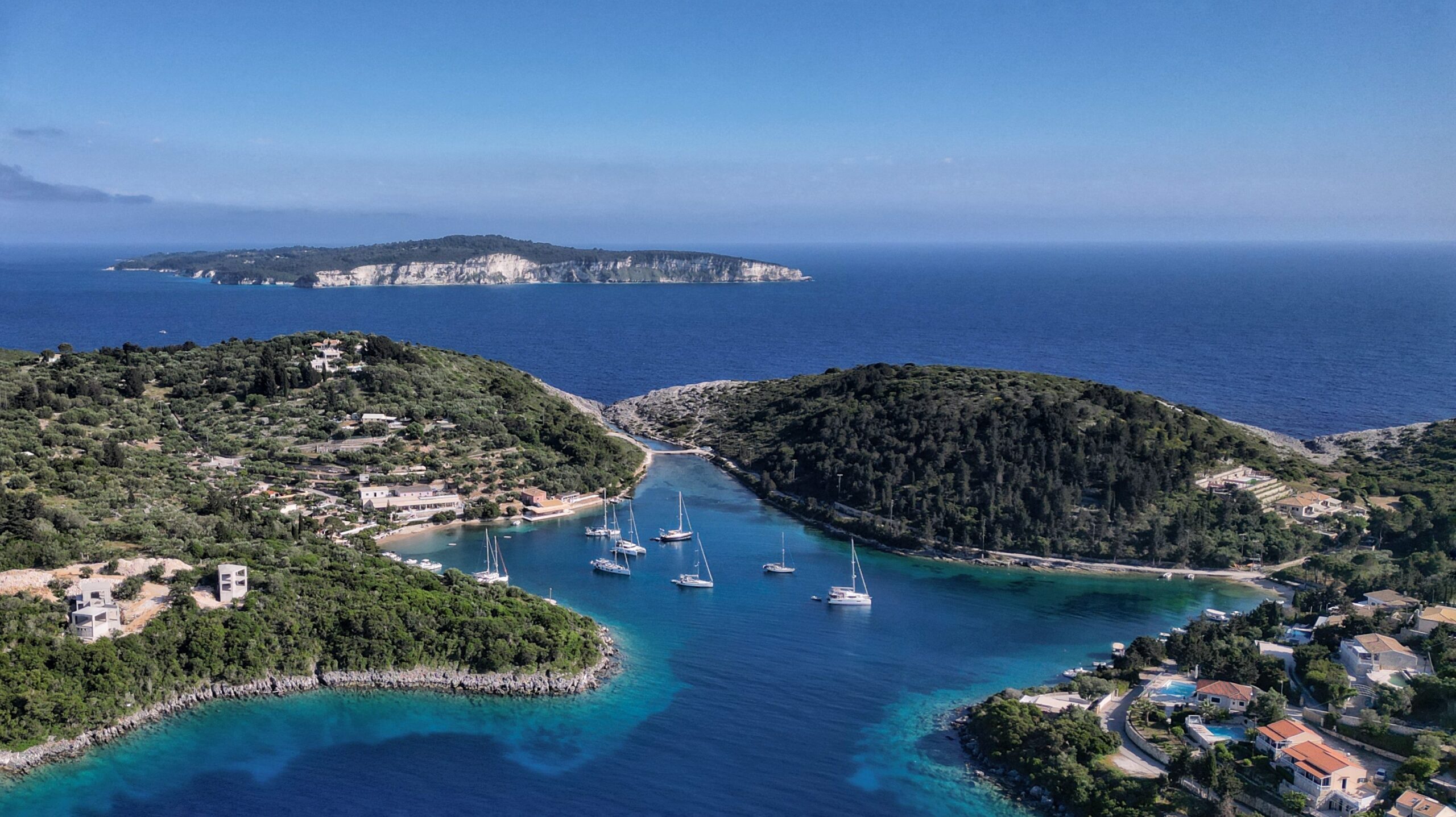
Where to Anchor Overnight Safely
In general, you want to anchor somewhere protected from wave action with good holding (e.g., sand or packed mud bottoms). While wind protection is beneficial, it is not always as important as swell and wave protection. Choose a bay sheltered as much as possible on all sides from the expected swell and wave angles, as well as the wind angle. This could mean sheltering behind a flat island where the wind blows over the land, but the sea state remains flat. In many Mediterranean countries, anchoring at the foot of a steep mountain may mean you get woken up in the middle of the night by katabatic winds falling off the cliffs, ruining a good night’s sleep.
Seagrass / Posidonia
Seaweed is terrible for anchor holding. Usually, the anchor gets caught in the strands, gives a weak hold, and then the roots break under load, leaving you dragging across the bay. Furthermore, Posidonia seagrass is strictly protected in many jurisdictions, which can lead to heavy fines if you are found anchored in it (or even if your chain drags across it). Look for clear patches of sand when you drop your anchor, and ensure your chain lies over sand whenever possible.
How Much Chain Is Out and Communication
Some boats have a chain counter at the helm, which comes with its own advantages and disadvantages. On All Winds, we don’t have one, so one of us goes forward to the foredeck when anchoring. We have our chain marked every 10 metres with bright paint, which works brilliantly (though it does need periodic repainting). To keep deck communications calm, we use a simple set of hand signals:
- At the Helm: When we reach the drop spot, the person at the helm holds up fingers corresponding to the desired chain length (3 fingers = 30m, 4 fingers = 40m).
- At the Bow: The person on the bow drops the anchor, gives a thumbs-up the moment the anchor hits the seabed, and then holds up fingers at every passing colour marker (2 fingers = 20m, 3 fingers = 30m).
This simple visual system means we can anchor smoothly without ever raising our voices over the wind or engine noise.
How Anchors Actually Work: The Angle of Attack
An anchor is designed to drag along the seabed until its fluke digs in, using the resistance of the bottom to set deeper as load increases. However, an anchor can only achieve maximum holding power if the pull on its shank is nearly parallel to the seabed at an angle of pull of approximately 10° or less.
- Parallel Pull (≤10°): The chain pulls horizontally along the sea floor. As the boat pulls back under wind load, the anchor buries itself deeper and achieves maximum resistance along the seabed.
- Upward Pull (≥15°): If the chain angle gets too steep, wave lift or wind gusts increase the upward vertical pull on the shank. This pulls the fluke out of the seabed, tripping the anchor.
The Freeboard Fallacy: The Math Most Calculators Miss
When sailors ask, “How much scope do I need?”, the standard textbook answer given by training bodies like the RYA is usually 4:1 for all-chain or 6:1 for rope-and-chain rodes. Some European skippers use rules of thumb like 2 × Depth + 15m. Many people—even quite experienced sailors—take these rules at face value and calculate scope using water depth alone. However, because the anchor line attaches at the bow roller, the vertical distance from the bow roller to the water surface (freeboard) must be included in your calculations. Unfortunately, measuring depth strictly from the seabed to the water surface while forgetting bow roller height is widespread.
On a modern 40-foot cruising yacht like All Winds, the bow roller sits roughly 1.5 metres above the water surface. If you anchor in 5 metres of water according to your depth sounder, the actual vertical distance from your bow roller to the seabed is 6.5 metres.
The Freeboard Maths Example:
Suppose you want a 5:1 scope in 5m of water depth on a yacht with a 1.5m bow freeboard:
• Flawed Calculation (Ignoring Freeboard): 5m × 5 = 25m of chain. (Your real scope is actually only 25 / 6.5 = 3.8:1).
• Correct Calculation (Depth + Freeboard): (5m + 1.5m) × 5 = 32.5m of chain.
By forgetting bow freeboard, you leave 7.5 metres of chain sitting unused in the locker and drastically steepen your chain’s angle of pull!
(Note: If I am anchoring in a shallow bay in zero wind for a quick swim while remaining on board, I may still just calculate water depth × 4 or 5. But as soon as I need to be certain the boat is staying put overnight, I make sure bow freeboard is included. The important point is to understand the physics first, then adapt your plan to the situation.)
The Freeboard Calculator
Correct Chain Needed:
32.5 m
Based on total vertical height (Depth + Freeboard)
If You Ignore Freeboard:
You would only drop 25.0 m of chain.
Your ACTUAL scope becomes:
3.8 : 1
Our Golden Rule on All Winds: Laying Cards on the Table
Ask 10 skippers about scope, and you’ll get 15 opinions. On All Winds, here is ours:
- The 5:1 Baseline: We use 5:1 (Depth + Freeboard) as our standard starting point. We drop, set, and test the anchor at this scope. In normal conditions, once set and verified, we are completely confident the boat is staying put.
- Tight Swing Room: If an anchorage is crowded and we are worried about swing radius, we may take in a small amount of chain after setting, but we try never to drop below 4:1 except in very exceptional circumstances.
- Blowing a Hooly: When katabatic winds or severe fronts threaten, we dump generous chain. On one occasion in Greece, facing 40-knot katabatic gusts, we let out 55 metres of chain in 5 metres of water (>8:1 scope!). We held so securely overnight that we almost had trouble digging the anchor back out of the seabed the next morning.
All of these formulas are rules of thumb—it’s vital to understand what is going on and adapt them to the situation. A 5:1 baseline gives you a cushion of extra safety. Once the anchor is buried, you can shorten scope back toward 4:1 or let out more depending on circumstances. Knowing the physics allows us to make educated decisions rather than blindly dumping a pile of chain on the seabed. I’ve sat in crowded bays and watched dictatorial skippers interrogate every newly arrived boat about how much chain they dropped, showing zero trust that newcomers might also know what they are doing—or might even have a better understanding of the math!
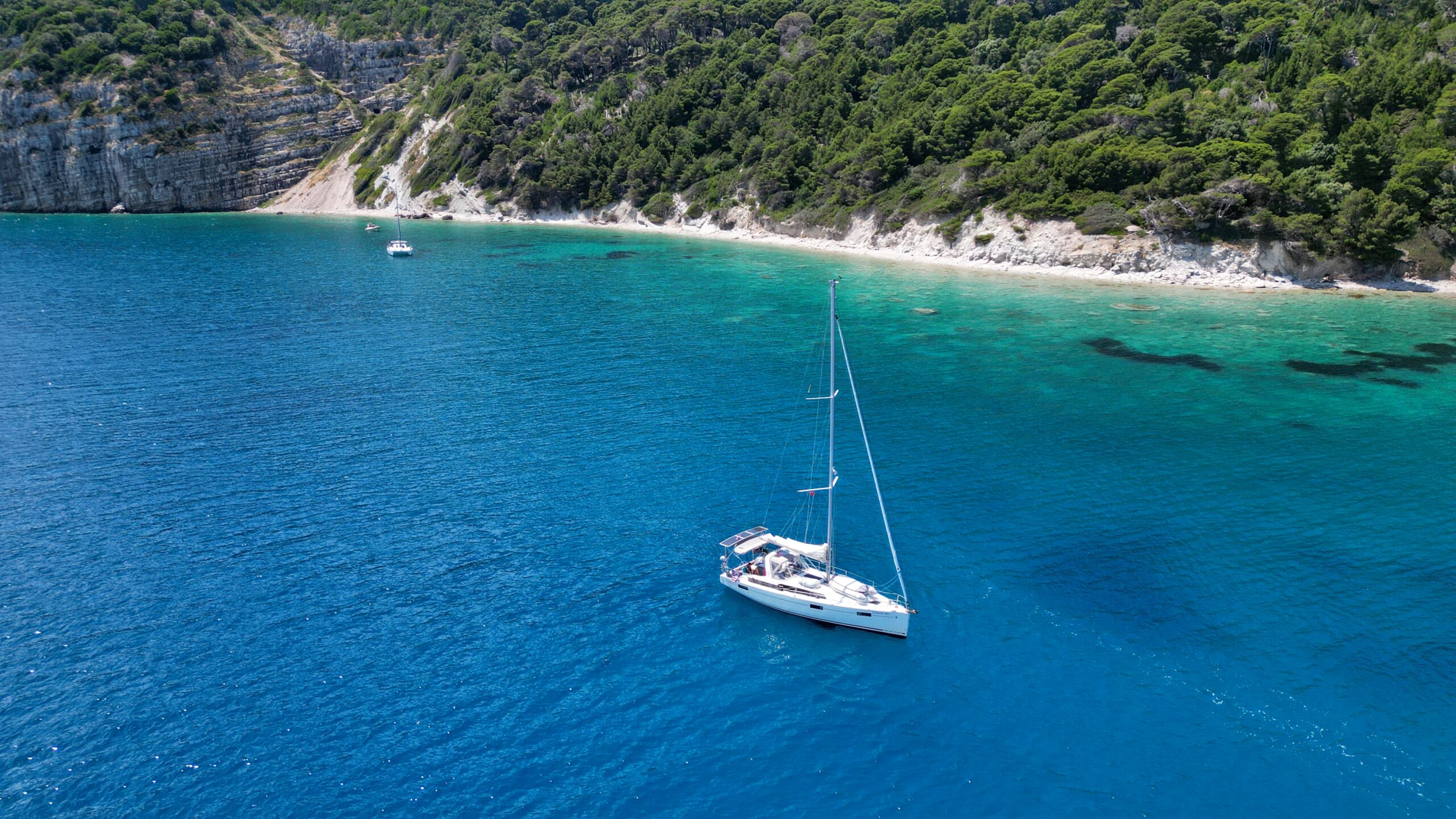
Tides and Currents: Sailing Beyond the Med
If you venture out of the tideless Mediterranean into waters with significant tidal ranges (such as the UK, Atlantic France, or the US East Coast), tidal calculations become critical for two reasons:
- High Water Scope: Calculate your scope based on the predicted depth at High Water. If you set a 5:1 scope at low tide in 4m of water with a 3m tidal range, your scope will shrink to a dangerous 3:1 when high tide rises.
- Low Water Clearance: Ensure you have sufficient depth under your keel at Low Water so you don’t ground when the tide falls. Always account for local tidal streams or reversing currents that will swing your boat in 180° arcs twice a day in semi-diurnal tidal areas.
Testing the Set: Why We Skip GPS Alarms for Real Physics
We are not big fans of relying solely on phone or plotter GPS anchor alarms. They are finicky to set accurately to the actual drop point of the anchor, your boat already moves 12 to 15 metres from the bow to the stern helm, and phone GPS units frequently drop satellite coverage inside a fibreglass hull during sleep mode. All of this leads to false alarms waking you up at 3 AM—or worse, an alarm that fails to trigger until you’ve already dragged 30 metres.
We are firm believers in a simple philosophy: set the anchor well, verify it physically, and listen to the boat.
When setting our anchor, we actively pay out scope over the ground as the boat moves backwards—never dropping the anchor and a lump of chain in a heap hoping the wind drags it straight. Once the anchor touches bottom, we lay the chain out along the sea floor, lock the chain clutch, and gently engage reverse. First, we let the boat settle at idle reverse. Once the chain takes initial tension, we systematically increase engine revs in reverse—1,500 RPM for an expected low-wind night, and 2,000+ RPM if we expect heavy weather.
While reversing under load, we verify holding using five physical checks:
- Beam Transits: Pick two fixed objects onshore that line up as close to 90° off the beam (side) of the boat as possible—for example, a navigational marker in front of a tree, or a chimney lined up with a hill peak behind it. If the boat is dragging, the two onshore objects will separate visually. If they remain perfectly aligned while the engine works in reverse at 2,000 RPM, you are dug in. (Pro tip: Don’t do what a student on a Powerboat exam I was assessing years ago did—lining up two sheep in a field! 😉)
- Feel the Chain: Place a foot gently on the anchor chain forward of the windlass while reversing. A dragging anchor vibrates and skips rhythmically across the seabed; a set anchor builds smooth tension and feels completely motionless.
- Visual Check: If the water is shallow and clear enough, look at a spot on the seabed next to the hull and verify you aren’t moving over it.
- Instrument Check: Check SOG (Speed Over Ground) on your GPS plotter. If it reads 2 knots backwards after the chain has taken tension, you are definitely not set!
- Listen to the Boat: Sleeping in the bow cabin gives you instant sensory feedback. If an anchor unseats overnight, you will hear and feel the heavy chain rumbling and dragging across the sea floor long before a GPS alarm triggers.
(Backup Note: While I don’t use an anchor alarm, if I need an extra layer of backup, I drop a marker on Navionics and leave track recording on. You can easily spot if your track remains in the same clean arc over and over again or if it breaks out perpendicular to your swing arc).
Protecting Your Windlass: Snubbers, Bridles & Dyneema Loops
An electric anchor windlass is designed to lift chain vertically—it is not designed to hold the immense, snatching loads of a yacht pitching in wind and waves. Leaving full load on the windlass internal gears will damage the drive motor and risk snapping the chain gypsy brake.
To protect the windlass, we take the load off the chain and transfer it to our bow cleats using a bridle with a chain hook. Ideally, use stretchy nylon mooring line for the bridle to absorb wave shock loads and eliminate snatching.
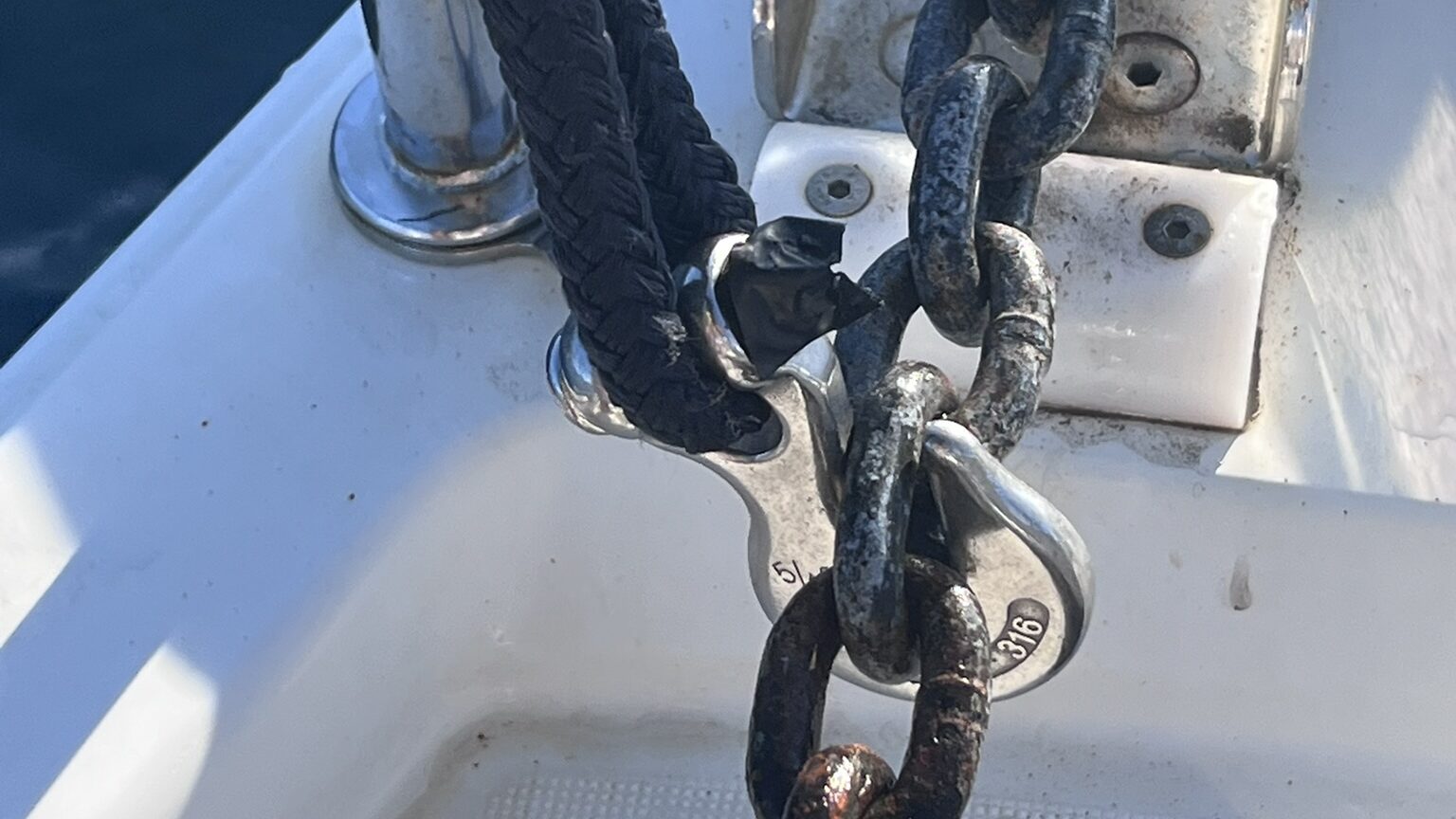
No Chain Hook? The Dyneema Loop Trick:
If you don’t have a metal chain hook, make a soft Dyneema loop (easy to splice if you have spare D12 Dyneema onboard). Cow-hitch the Dyneema loop directly around a chain link, tie your nylon bridle lines to the loop, and ease the windlass until the Dyneema loop and bridle take 100% of the load.
Stern Anchors, Shore Tying & Springing the Chain
In narrow coves or crowded creeks where there is zero room for a 360° swing radius, alternative anchoring techniques are essential:
- Shore Tying: Drop your bow anchor in the middle of the cove, reverse toward the rocks, and send a crew member ashore in the dinghy (or swimming with a line) to tie long stern lines around a solid rock outcrop or shore bollard. This keeps your bow pointed into the swell while preventing the stern from swinging into shallow rocks.
- Stern Anchors in Narrow Inlets: If shore tying isn’t possible, set your bow anchor hard, pay out extra chain, and drop a secondary stern anchor (either off the stern or carried out via dinghy). Winch forward on the bow chain to dig the stern anchor in. (Tip: Attach a fender as a float to the stern anchor line, and secure the line to a stern bridle so you can drop it instantly in an emergency and retrieve it later).
- Springing the Chain to Align with Swell: If an anchorage features a nasty cross-swell that rolls the boat violently overnight, you can alter the boat’s heading relative to the anchor chain. Attach your Dyneema loop or chain hook to the anchor chain forward, tie a long mooring line to it, and lead that line past a stern cleat to a cockpit winch. Ease out the main anchor chain so the hook drops underwater, and winch in the stern line. This pulls the stern around, aligning your bow comfortably into oncoming waves even if the wind is blowing from a different angle. (We used this exact setup off both the bow and stern during an uncomfortable, sleepless night off the coast of Albania to align All Winds between two competing swell patterns!).
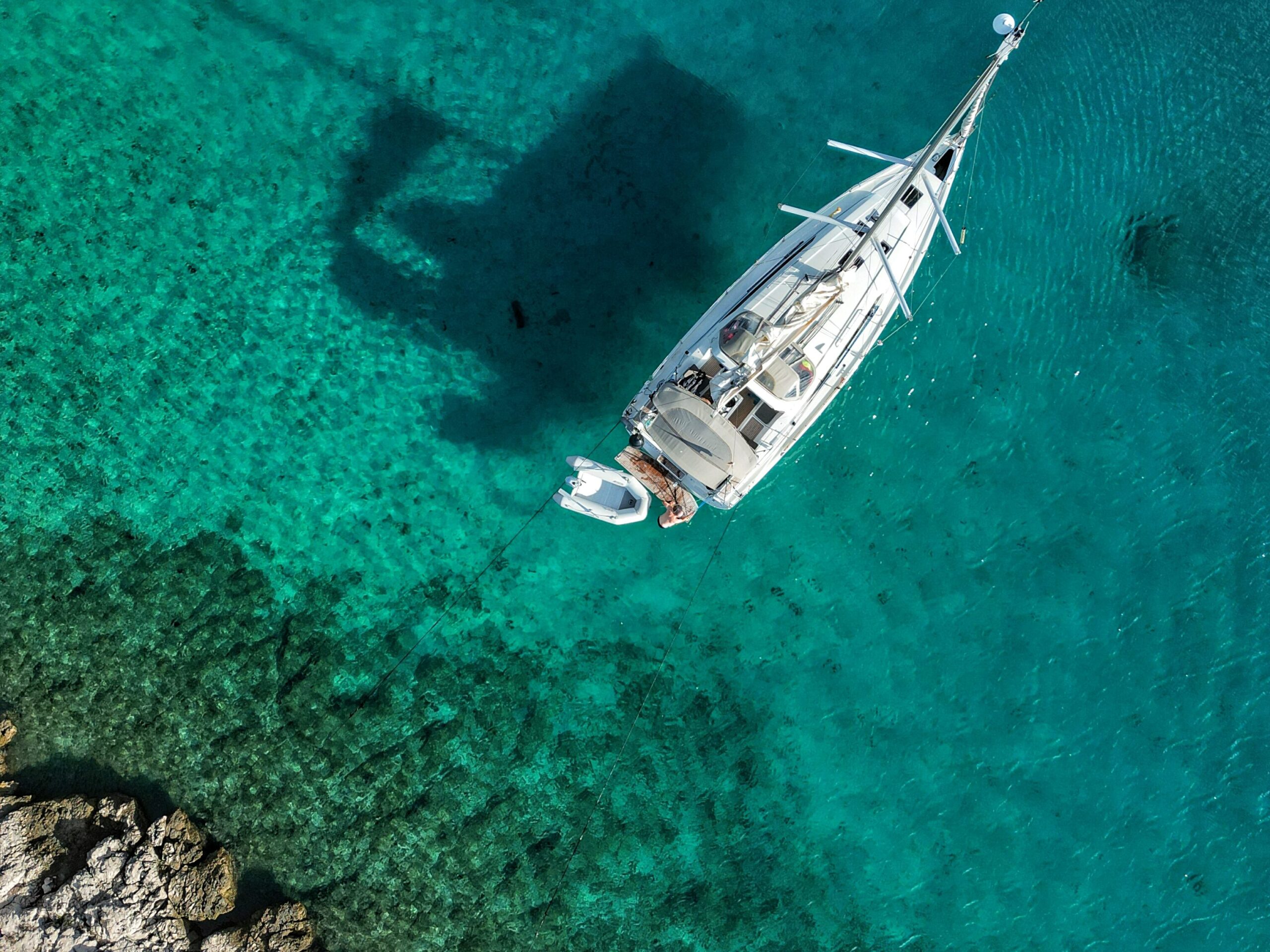
Fouled Anchors & Cable Snags
If your anchor becomes fouled on the bottom, it can lead to high stress quickly:
- Reversing the Pull: The first step is to manoeuvre the boat directly over the anchor and drive in the opposite direction from where you set it, pulling horizontally from the reverse angle. In many cases, this will free an anchor buried deep in mud or soft debris.
- Dropping a Weight Down the Chain: If the anchor is jammed firmly under a rock or ledge and it’s too deep to dive, bring the chain as vertical as possible and drop a heavy weight on a line down the chain. Providing the shank can be lifted, this weight can be used to pull the shank from the opposite direction to free the fluke. (There are dedicated anchor trip tools for this, but you can McGyver one using spare shackles or heavy gear onboard).
- Snagged Underwater Cables or Other Anchors: If your anchor pulls up an old cable, chain, or someone else’s anchor, the easiest solution is to pass a line underneath the obstruction, tie both ends of the line to your bow cleats, and let the line support the weight of the obstruction. Then, ease your anchor chain down so the fluke falls clear of the cable. Once your anchor is free and hoisted to the bow roller, release one end of the support line from the bow cleat to drop the obstruction back into the water.
What to do if you drag?
First things first, don’t panic. If your anchor breaks out (and you have enough scope on a favourable bottom then there is a reasonable chance it will reset. If you don’t have enough scope out, then that is your first move; chain in the locker is not doing anything to help you stay put; get more out. This may feel contradictory when you are dragging backwards to let the boat further back on the chain, but the first thing is to give the anchor a favourable location to bite.
If the seabed is unfavourable or it is not possible to let more chain out either due to being too close to land or other boats, then the preference is to take the anchor up and reset it in a more favourable location.
A temporary fix in some cases may be to motor against the wind to take pressure off the anchor. While this can be of some help in extreme conditions, it is actually quite difficult to keep the boat into the wind when it’s blowing a gale straight on the bow. You don’t want to drive over your chain, but you will need to get a bit of way on the rudder to keep the boat pointing into the wind, and you may be able to reduce the load that the anchor is under in extreme situations.
As with many things, prevention is better than cure. Get your anchor set, get enough chain out and plan ahead. This is always better than reacting. Read our posts on using Weather Apps and Convective Storms like the Nevera in Croatia to try and reduce the risk of being overwhelmed by a violent storm at anchor.
Take the Guesswork Out: The All Winds Toolbox App
To take the mental arithmetic out of anchoring after a long passage, we built a dedicated Anchor Scope Calculator directly into the All Winds Toolbox app. Simply input your depth sounder reading, bow freeboard height, forecast peak wind speed, and expected tidal rise. The app instantly calculates your exact required chain length, recommends snubber dimensions, and evaluates your risk profile against our Go / No-Go Decision Matrix.
Mastering anchor mechanics, reading seabed holding, and managing short-handed deck workflows are core components of our real-world training. Join us on an upcoming Skipper Coaching & Seamanship Week in Croatia to practice heavy-weather anchoring and boat control with experienced coaches.
Yes, absolutely. Anchor scope is defined as total rode length divided by total vertical height from the seabed to the bow roller. If your water depth is 5 metres and your bow roller sits 1.5 metres above the waterline, your vertical height is 6.5 metres. Calculating scope using water depth alone results in insufficient chain length and a dangerous, upward pull on the anchor shank.
For a comfortable overnight stay on an all-chain rode in moderate conditions, a baseline scope of 5:1 (calculated as Water Depth + Bow Freeboard) is recommended. In tight coves, you can shorten to 4:1 after setting, but in forecast winds exceeding 25-30 knots, expand your scope to 6:1 or 8:1 to ensure the angle of pull remains horizontal.
An electric windlass is designed to lift chain vertically, not hold heavy wave shock loads. In wind speeds over 20-25 knots, catenary flattens, and chain becomes a rigid steel bar. A 6 to 8-metre elastic nylon snubber or bridle takes the load off the windlass gears, dampens snatch loads, and prevents the anchor from being yanked out of the seabed.
Reverse under engine load (1,500 RPM in normal conditions, 2,000+ RPM in heavy weather) and check a shore transit off the beam (lining up two fixed objects 90° off the side of the boat). If the shore objects remain motionless while the engine works in reverse, you are set. You can also place a foot on the chain to feel for smooth tension versus dragging vibrations.
Attach a Dyneema loop or chain hook to the anchor chain forward, tie a mooring line to it, and lead that line past a stern cleat to a cockpit winch. Ease the anchor chain out so the hook drops underwater, and winch in the stern line. This pulls the stern around, aligning your bow comfortably into oncoming waves even if the wind is blowing from a different angle.

No responses yet