
My social media feeds are permanently cluttered with Hafenkino—that classic dockside drama of harbour manoeuvres going catastrophically and expensively wrong for the entertainment of onlookers. Let’s be completely realistic: while these incidents look dramatic, it is relatively rare that they result in significant damage. A minute of inattention or a slight misjudgement can happen to anyone, whether they have five years of experience or thirty-five. I would argue complacency in an experienced skipper can be just as bad as a new skipper gaining experience.
Key Takeaways for Skippers
- The Fear Trap: High-stress docking anxiety floods your brain with cortisol, blocking physical skill learning. Marina stress is largely manufactured by “quick-fix” course providers and clickbait social media posts.
- Macro to Micro Physics: Boat control is a single, unified skill set. Master wind awareness, momentum, and leeway in open water, build your skills toolbox, and marina handling falls naturally into place.
- Canvas Over Diesel: Sailboats are designed to operate under canvas; engines are auxiliary. Practising basic sail handling in tight spaces builds true self-reliance.
- Objective Risk Control: Borrowing from Swiss avalanche safety science, the Skipper’s Decision Matrix™ gives developing skippers a practical framework to strip emotion, schedule pressure, and ego out of passage decisions.
If you’re a developing skipper, combine this weather data with the All Winds Skipper Toolbox to assist with your daily go/no-go decisions.
If a boat is moving at a controlled, conservative speed, the physical outcome of a mistake is usually minor—a scratched fender or a bit of rubbed gelcoat. The real structural damage and safety crises occur during panicked, high-throttle thrusts born entirely out of stress and pre-manoeuvre anxiety.
Avoiding the water because you dread the marina is like refusing to go for a Sunday drive because you’re worried about parallel parking when you get home. The actual docking sequence represents a tiny fraction of your day on the water. Furthermore, you are rarely trapped without choices.
Critics often point out that a boat isn’t like a car because it doesn’t have a brake pedal. Mechanically, that’s true. But practically? It is no different from skiing. Skis don’t have brake pedals either, yet no one panics that a skier is helpless on a mountain. You stop by applying edge control and creating deliberate resistance against the surface.
On a sailboat, your ‘edge’ is neutral combined with active, controlled reverse thrust. It is remarkably effective at taking the way off the hull and bringing forward momentum to a dead stop. The real shift between driving a car and steering a boat isn’t that a boat can’t stop—it’s that once you take the way off, you transition from driving physics to drift physics. That isn’t a panic moment; it is simply a variable you plan for.
The media—and a specific subset of commercial coaches—want you to believe the marina is a lawless, unpredictable gauntlet. It isn’t. The fear is manufactured, because fear sells snake oil.
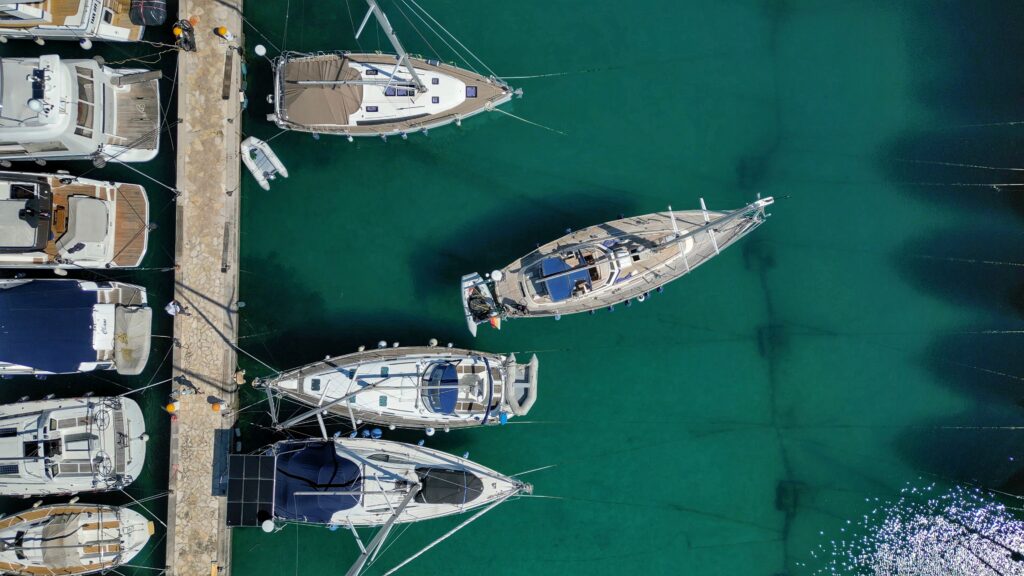
The Learning Permit: Building Independence, Not Anxiety
There is a glaring irony in criticising some of the commercial sailing industry when running a business that offers coaching. The difference lies entirely in pedagogical philosophy.
If an instructor relies on fear to teach, they create a massive psychological hurdle that takes months—or years—to undo. High anxiety floods a student’s system with cortisol and adrenaline, which actively blocks motor-skill acquisition and destroys spatial awareness. You literally cannot learn to develop a feel for a boat when your brain is locked in a fight-or-flight response. The industry creates this panic, freezes the student’s brain, and then sells them a proprietary “masterclass” to cure the very anxiety they manufactured.
Having coached watersports since the early nineties—with a rewarding fifteen-year chapter coaching mountain biking before returning fully to my core competence on the water—I’ve started every course with the exact same truth: Today is not the end of your learning; today is the start.
A Day Skipper certificate—or any sailing qualification—is simply a learning permit. An instructor or coach’s job isn’t to make a student instantly infallible or to sell them a secret recipe. The job is to provide clear mental models, analyse what the student is doing, give direct feedback, and hand over a set of practical tools. What the student does with those practice tools after the course dictates how they grow into a confident, self-reliant skipper. (I’ll let you into a secret – even after close to 40 years on the water, every day is still a school day for me!)
The Car Park Flaw: Learning Boat Handling Backwards
Dedicating the guts of a week’s training syllabus exclusively to box-berthing and pontoon returns is like trying to learn to drive on the motorway by spending fifty hours in a crowded supermarket car park. Yes, close-quarters parking must be understood, but it should never dictate the curriculum. Yet, we see a massive shift toward marina-centric training, which ultimately breeds an over-reliance on bow thrusters as a permanent crutch rather than a tactical tool.
You will learn far less about how to handle an 8-tonne displacement hull in the high-stress, low-margin environment of a tight marina fairway than you will out on the open water. Boat control is a single, interchangeable skill set. When you master macro physics where there is space to make mistakes safely, the micro skills required for the harbour naturally fall into place. Skills breed skills, and it works both ways.
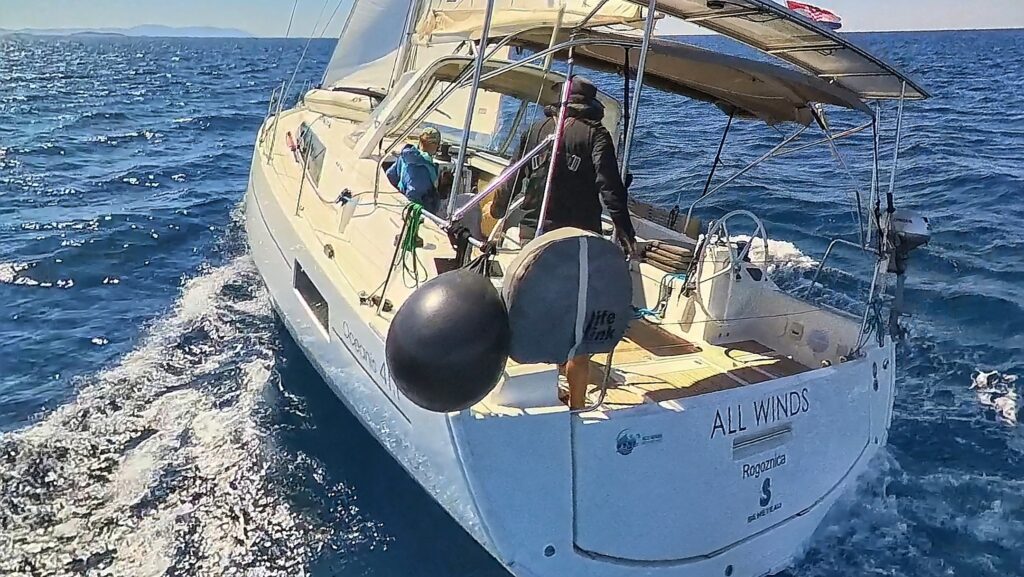
The Open-Water Simulator
The deep, instinctual understanding of wind awareness and momentum required in a marina is the exact same skill set you develop through specific open-water disciplines:
- Wind Awareness: A complete skipper feels gusts, adjusts course to keep the sails full, and tracks wind angles during tacks. This identical awareness tells you precisely how the bow will blow off, and how fast, the moment you take the way off the boat inside a windy fairway.
- Momentum Control: Practising picking up a mooring buoy or leaving an anchorage under sail forces you to judge the boat’s carrying power and exact deceleration curve without the safety net of an engine throttle.
- Decoupling Prop Walk: Reversing to lay out anchor chain when setting an anchor teaches you the exact speed threshold at which water flow over the astern rudder overcomes prop walk to give you directional control. That threshold is identical when backing into a berth.
- The Quick-Stop Rescue Drill (Pinned-Sail MOB): Turning and stopping the boat with the sails sheeted completely flat is a technique sometimes used during MOB practice. But it is also a double-duty training tool: it deliberately maximises lateral drag and forces the boat to slide sideways; it gives you a safe, open-water simulator for how a high-freeboard modern cruiser behaves when caught by a crosswind. (Before the critics eat me alive, yes I know the bow won’t blow off as much in this situation, but we are talking about developing feel in a wide range of circumstances to be able to understand what is happening and react correctly)
When you learn to manoeuvre a boat using only the wind and your sails, you develop an intuitive understanding of momentum and windage. Once you master that, turning on the engine in a tight marina feels easy, because you are no longer fighting the wind—you are using it.
Reclaiming the Primary Drive
There appears to be a skill gap in modern cruising culture, particularly in the Mediterranean. Too many sailors have come to view a sailboat as a motorboat with a decorative rig. They treat the engine as the primary power source and the sails as an optional accessory. When the engine stutters in a tight channel, complete panic sets in because they believe the boat is suddenly immobilised.
On a sailboat, the sails are your primary drive; the engine is auxiliary.
Building capability means intentionally flipping that dynamic back to where it belongs. When my partner Karin and I sail for ourselves, we regularly sail on and off the anchor. When we short-tack up a narrow passage like the Verige Strait in Boka Bay, we aren’t doing it to show off. We are using our primary propulsion system; if something goes wrong, the engine is always there as an auxiliary. – and let’s face it, sailboats are designed to – SAIL!
You can practise using your sails in tight spaces while you have an engine running safely in neutral, you calibrate your judgment. If a real mechanical failure ever happens in a narrow fairway, you don’t panic or beg for a tow on the VHF. You deploy some canvas and sail yourself out of trouble.
Three Home Truths About Marina Physics
When we strip away the drama, the physical realities of a non-tidal marina are highly manageable. (Tides introduce another factor, but even that is not unmanageable!)
1. A Moving Boat is a Stable Boat
Water flowing over the keel and the rudder creates stability and tracking. When a boat is moving under controlled power, this flow significantly reduces drift caused by the wind. In light winds, a modern boat with a fin keel will track cleanly at just 1 knot. Even in a 25-knot blow, you rarely need to exceed 2 to 3 knots to maintain steerage. While 3 knots feels fast if you hit something, the wind itself acts as a natural brake (if you set up your approach into the wind) to slow your forward momentum. Keep the boat moving until you don’t have to, and have a clear plan for the exact moment you stop.
2. The Wind Gradient Illusion
Your masthead anemometer might read 25 knots, but what the hull experiences down at water level is normally a fraction of that. Marinas are sheltered by concrete walls, breakwaters, and rows of large yachts. While the wind inside a fairway can bend and become gusty, its overall velocity is drastically reduced compared to the open sea. This is not to say there is no wind effect, but it is often not the massive drama it is sold to be and with good planning it need not be any drama at all.
3. Fenders Are Tools, Not Confessions of Failure
The modern “contactless fairytale” dictates that touching a pontoon or another vessel is a sin. In Mediterranean mooring, boats are structurally designed to sit packed tightly together. Deliberately choosing to rest your fended topsides against a neighbour under controlled power to stabilise your position is smart, practical resource management. It is infinitely safer than letting the bow drift wildly across an empty berth because you were too proud to use the physical environment to your advantage. It took me some time to learn this myself until I was once forced to back into a space smaller than the beam of the boat I was on with base staff on the two boats on either side motoring ahead against stern lines trying to make the minuscule gap as large as possible!
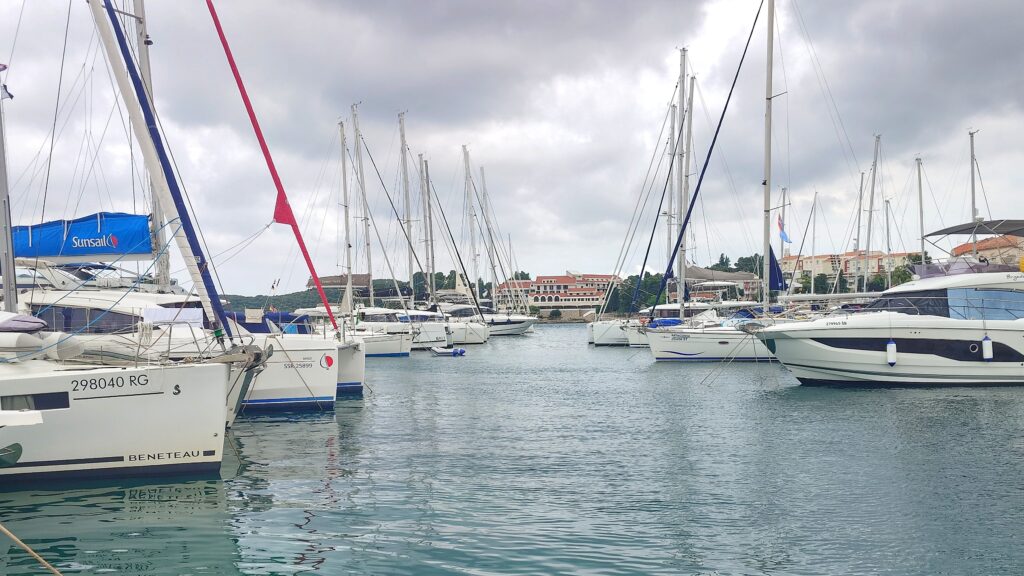
Tactical Risk Management: Objective Frameworks for Developing Skippers
Real seamanship isn’t hoping an overworked, stressed marinero drops everything to save you on a Friday afternoon during the high-summer rush. True self-reliance means mitigating risk long before you enter the breakwater.
An experienced skipper rarely writes down a risk assessment—they process the variables intuitively in seconds because they have thousands of sea miles of mental data to draw from. A developing skipper doesn’t have that internal database yet. In those early years, decision-making is easily hijacked by time pressure, crew expectations, or performance anxiety.
That is why developing skippers benefit from an objective framework. It isn’t about following rigid rules or acting like a commercial sea dog; it is about having a practical method to strip away emotion and evaluate three core realities before weighing anchor:
- Human Capacity: What is the experience level and fatigue of the skipper and crew?
- Environmental Load: What are the wind, sea state, and visibility doing?
- Destination Risk: Is the berth protected, or are you approaching an exposed lee shore?
When those variables stack up, a good skipper doesn’t just cross their fingers and hope. They look for tactical levers to pull the risk back down to a manageable level.
Timing is one of the most effective levers you have. For example, if you are returning a charter boat on a Friday, the worst tactical move a developing skipper can make is joining the 17:00 rush at the fuel dock alongside thirty other stressed crews. You can have a flawless week at sea, but if the final thirty minutes turn into a high-stress shouting match in front of a crowded quay, that chaos is what stays with you and your crew.
You don’t change the marina’s physical layout—you change your schedule. Planning your passage to arrive early at 14:00 gives you an empty fuel dock, clear fairways, and the spatial freedom to execute your manoeuvre with complete peace of mind.
And if the physical variables at a destination are stacked too high—like a surging, exposed quay in a heavy crosswind—an objective framework gives you the clarity to accept a simple truth: it is an unsafe berth. It takes the decision out of the emotional realm and makes the outcome straightforward. You turn around, head back out, and drop the hook outside until conditions settle.
Use our interactive calculator below to evaluate your passage variables and test your tactical safety mitigations before your next voyage.
From the Mountains to the Sea: The Origin of the Matrix
In backcountry ski touring, avalanche safety doesn’t rely on guesswork or rigid rules. The 3×3 Reduction Method is often thought to objectify risk management. It is a framework developed in Switzerland to eliminate human cognitive bias, fatigue, and group pressure before stepping onto an exposed slope.
In recreational sailing, skippers fall into the exact same mental traps: push-it-itis, time pressure on a Friday afternoon, overestimating crew capability and underestimating the conditions. Yet, until now, the marine industry has never had a dynamic equivalent to the backcountry reduction method.
We created the Skipper’s Decision Matrix™ at All Winds Adventures by rebuilding Werner Munter’s 3×3 avalanche reduction framework from the ground up for the marine environment. It is a completely unique risk-assessment tool designed specifically for developing skippers to weigh Human Capacity, Environmental Load, and Port Risk—giving you objective scaffolding to make calm, authoritative calls. This and further tools are available on our First Time Skippers Guide
All Winds Skippers Decision Matrix™
Honest input = Safe Sailing.
Now Available in our All Winds Skippers Toolbox App
Conclusion: Building Objective Capability
A nervous skipper guarantees a nervous crew and a stressed boat—which is the ultimate reason the industry needs to stop selling fear. We aren't trying to breed arrogance; we are building objective capability and genuine seamanship and trying to avoid clickbait to sell snake oil.
Assess what the boat, the crew, and the conditions allow, give yourself the practice tools to execute your plan, and always keep an escape route ready in case things go pear-shaped. The harbour doesn't have to be a monster, because when skills breed skills, your toolkit is already big enough to handle it.
If you are ready to stop practising in the car park and want to build real, intuitive boat control on the open water, join us in Croatia. We don't teach to a rigid test—we teach you how to sail. Explore Our Skipper Confidence Weeks Today—or share your own learning experiences in the comments below.
Marina docking stress is largely psychological, driven by public spectator pressure (Hafenkino) and fear-based training methods. Physically, a boat moving at controlled speeds experiences minimal risk. Most docking mistakes are easily managed using neutral gear, reverse thrust, and proper fender placement. High anxiety floods the brain with cortisol, which freezes motor-skill acquisition.
Close-quarters handling and open-water sailing rely on identical hydrodynamic and aerodynamic principles. Practising wind awareness, momentum management, prop-walk compensation during anchoring, and lateral leeway during rescue drills on open water builds the exact spatial judgment needed to steer inside a tight marina fairway.
The Skipper’s Decision Matrix™ is a marine risk-assessment framework developed by All Winds Adventures. Adapted from Werner Munter’s 3x3 Reduction Method used in Swiss avalanche safety, it provides developing skippers with an interactive tool to evaluate Human Capacity, Environmental Load, and Port Protection before setting sail, stripping away schedule pressure and ego.
The most effective tactical risk mitigation for returning a charter boat is adjusting your schedule to arrive early (e.g., by 14:00). Arriving before the peak 17:00 rush avoids crowded fuel quays, congested fairways, and unnecessary time pressure, turning a high-stress manoeuvre into a calm, controlled arrival.
Crew anxiety is rarely inherent; it is a direct reflection of the skipper’s energy. If a skipper hesitates, projects panic, or shouts, the crew reacts in kind. To maintain a calm boat: Give a clear, quiet briefing before entering the breakwater. Assign single, uncomplicated tasks (e.g., handling one stern line, not three things at once). Ban shouting on board.
Set the clear expectation that aborting an approach to go around for a second attempt is normal, calm seamanship—not a failure.
Bow thrusters are a back-up, not a primary steering mechanism. If the bow isn't coming around quickly enough, a short burst can rescue the situation, but it is never meant to be the main tool to turn the boat. There is a massive over-reliance on them today—to the point where skippers are using bow thrusters while laying anchor, which demonstrates a fundamental lack of boat control and wind awareness. Learn to feel the boat and execute the manoeuvre without the thruster first (because mechanical systems will fail at some point), and keep it in reserve as a tactical backup when you need a momentary touch of assistance.
You should abort a manoeuvre the moment you sense that you may not be in control; it's better to abort early and reset than to get stuck in a situation with no way out. An unexpected gust pushes the bow off course, or crew members are forced to reach dangerously to catch a line. Aborting is sound seamanship. Re-establishing control in neutral, backing out into open fairway space, and resetting your approach is always safer than trying to force a bad position under high throttle. After an abort, take some time to reset, drive right out and give yourself time to get your head back in the game before reattempting the manoeuvre. In our Catastrophe management article, we talk about a reset button.
Prop walk is the lateral push of the stern caused by the propeller blades in reverse before water flows over the rudder. Instead of fighting it, use it to your advantage: angle the boat slightly off-alignment before engaging reverse so that prop walk pulls the stern directly into position, or burst into reverse early to get water flowing over the rudder blade so steering control overrides the walk. Also, low revs will give you less prop walk; if possible, slow the boat down (plan ahead) and engage reverse gradually (if you have room) as soon as the boat starts to move astern, steerage overcomes prop walk. If you give lots of power to stop and reverse, you will get lots of prop walk.
A Day Skipper certificate (or most basic skipper qualifications) is effectively a learning permit, and how ready you feel upon completing it depends heavily on the prior experience you bring to the course. Someone with a background in dinghy sailing or windsurfing already has an intuitive, muscle-memory grasp of wind awareness and balance. However, a complete novice is building that foundation from zero. Qualifications prove you understand navigation, safety, and core theory, but true self-reliance comes from treating your post-certification voyages as structured practice—systematically testing boat handling in calm conditions before pushing into higher winds or tighter marinas.

No responses yet