
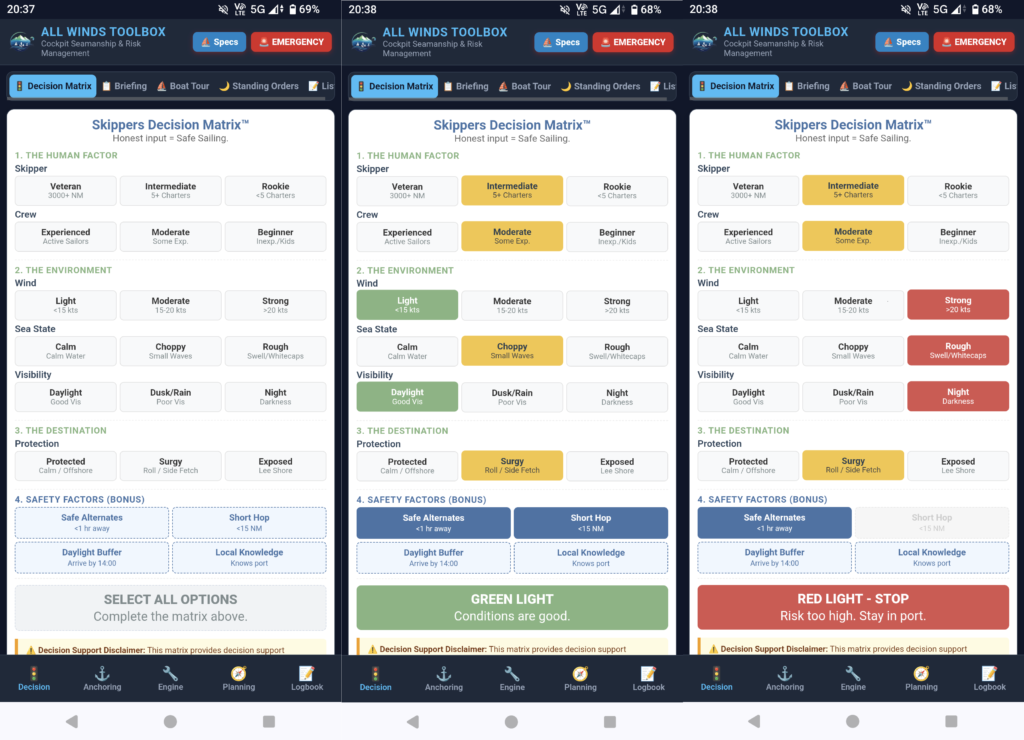
The All Winds Skipper Toolbox is a mobile Progressive Web App (PWA) designed to manage skipper risk, anchored by its flagship engine: the Skipper’s Decision Matrix™.
Most charter holidays begin with a flurry of administrative chaos. You survive the base check-in, locate the hidden circuit breakers for the bow thruster and windlass, check the gas solenoid, and unpack the supermarket bags.
Now the crew looks to you and asks the age-old question: “Where are we sailing tomorrow?”
The common temptation for new skippers is to ignore the wind entirely. They fixate on a specific restaurant someone recommended on social media or try to follow a rigid itinerary like a road trip. On the water, this leads to two potential problems: either running 30 miles downwind on Day 1 and facing a brutal upwind slog to get back on Friday, or slamming straight into a heavy head sea with an exhausted, seasick crew.
Having spent years teaching outdoor and watersports, I’ve long been fascinated by the “Human Factor” in accidents—how even experienced skippers can make poor calls under subtle pressures like fatigue, optimism bias, or “get-home-itis”.
In mountain and avalanche safety, risk-reduction frameworks like Munter’s 3×3 method have been used for decades to remove emotion from critical decisions. We adapted those exact human-factor principles to seamanship, introducing our Decision Matrix in the original First-Time Charter Guide.
Interestingly, when we showed this framework to experienced circumnavigators and single-handed offshore sailors, their response was immediate: “This matrix codifies exactly what goes on in our heads when making a passage plan.”
| Cockpit Need | Onboard Plotter (GPS) | All Winds Skipper Toolbox |
|---|---|---|
| Primary Focus | Spatial Navigation & Depth | Complete Cockpit Seamanship |
| Flagship Engine | Satellite Maps | Skipper’s Decision Matrix™ |
| Go/No-Go Call | Gut Feel / Intuition | Traffic-Light Risk Calculations |
| Integrated Utilities | Charts Only | Scope Calculator, W.O.B.B.L.E., Deck Log |
📲 Try the All Winds Toolbox (v0.9 Beta)
We’ve compiled our core seamanship frameworks from our First-time Charter Guide into a free, lightweight mobile Web App designed specifically for offline ease of use onboard.
- 100% Offline First: Saves directly to your phone’s memory—functions in remote bays with zero cell signal.
- Easy to Install: No App Store download, no sign-up, no ads, and 100% free.
- Key Tools On Board: Skipper’s Decision Matrix™, Instant Scope Calculator, GPS Fix Logger, Custom Emergency VHF Scripts, and Sea Time PDF Generator.
(To use it offline at sea, open the link in Safari or Chrome on your phone and select “Add to Home Screen”).
Know someone planning a charter this season? Share this article or send them the link to help keep their trip safe and stress-free!
📜 License & Sharing:
The All Winds Toolbox and Skipper’s Decision Matrix™ are 100% free to use and share for personal cruising. If you are a charter operator, sailing school, or commercial maritime business interested in using or integrating these tools, please contact us to discuss licensing.
1. Pre-Trip Provisioning & On-Board Briefings
The app is designed to be useful well before you ever set foot on the pontoon. One of the biggest headaches before casting off is coordinating groceries with a group. Using the Provisioning List in the app, you can draft your core shopping needs, send the list directly to your crew via WhatsApp, and have them text back missing items or personal preferences. You land at the local supermarket with a single, consolidated list ready to go.
Boat Briefings vs. Route Briefings
Once on board, everyone wants to go, but there are many tasks to be completed before untying the lines. To make sure everyone is on the same page, it is a good idea to complete your Boat & Safety Briefing before you ever sit down with a chart to discuss destinations. The crew needs to understand how the vessel works before they worry about where it’s going.
Keep in mind that the briefing checklists in the app are designed as memory joggers, not rigid step-by-step scripts. Every boat layout and crew dynamic is unique. Use them as quick visual prompts to cover the essentials:
- Safety & Emergency Gear: Lifejacket fitting, harness points, horseshoe buoys, fire extinguishers, engine bay fire ports, and flares.
- Below Deck Operations: Gas shutoff valves, marine head operation, and seacock locations.
- Engine Controls: How to power up the control panel, start/stop the engine, and operate the throttle (modern charter panels use push-buttons, not ignition keys!).
Planning WITH the Wind (Not Fighting It)
Once the safety tour is complete, pull up the weather forecast (we personally like Windy along with the local sea area forecasts, but there are also other options) to plan your route. If you are wondering, “How much wind can I actually sail a charter boat in?”, your first reference should be your charter contract fine print. Most fleet operators include explicit wind limits (often Beaufort Force 6 or ~22–25 knots) above which setting sail or leaving port is contractually restricted without express permission from the base manager. (We’ve experienced anything from force 5 to 7 written in contracts)
When designing your itinerary:
- Avoid the Fixed Itinerary Trap: Never commit to a rigid daily schedule. Explain the weather to your crew so they understand why you are choosing specific bays.
- Time the Weather Changes: Look for forecast weather changes mid-week. If the wind is predicted to change on Wednesday, you can often enjoy a comfortable downwind run both heading out and coming back.
- Use Island Shelter: Sail downwind in open water on the outside of island chains (weather permitting); return upwind in the protected, flat water inside island channels to avoid slamming chop.
Taking the Pressure Off the Skipper
If you are unsure whether a planned leg is suitable, run your scenario through the app’s Skipper’s Decision Matrix™. Using an objective tool takes the personal pressure off you as a skipper. If the matrix outputs AMBER or RED, you can show the crew: “It’s not just me being overly cautious; the objective data shows our risk level is too high for today.”
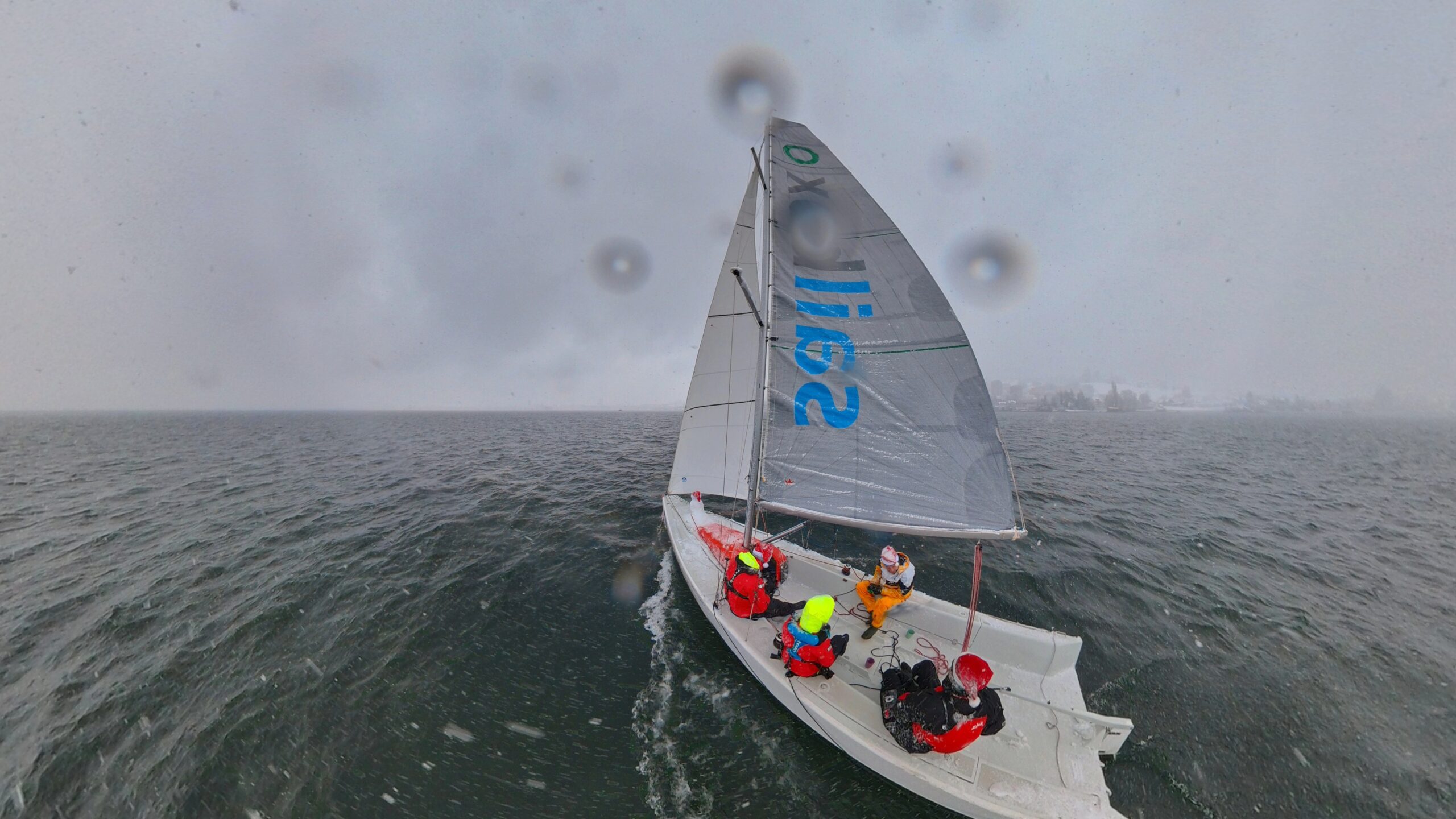
Be honest about crew abilities. A crew with two charter holidays under their belt might feel slightly insulted if the tool classifies them as beginners rather than intermediates, but a bruised ego on the pontoon is infinitely better than realising experience fails them when caught in a 40-knot Meltemi or Bora.
⚓ From our experience: We tend to charter (and sail our own boat) in the shoulder seasons—April and October. Quiet waters and empty anchorages are fantastic, but off-season weather systems can be punchy. On more than one trip, we’ve made the conscious decision to stay put on Day 1 due to winds that were simply not conducive to a pleasant sail. Despite having nearly 40 years on the water each and having experienced 50 knots on other watercraft, we feel zero need to go searching for survival conditions on a cruising yacht. Never let your ego override your comfort or crew safety.
2. Morning Departure: Engine Discipline & The Final Go/No-Go
Even when chartering, it’s still a good idea to do an engine check a few times during the week. You aren’t just looking at static fluid levels; you are looking for trends. An engine bilge that was bone dry on Sunday but has two inches of salt water on Tuesday might indicate a leak in a raw-water hose or shaft seal. This may give you advanced warning of a problem, but also gives you valuable information to give the base staff when you check back in so they know what they might need to look at before the boat goes out for the next crew.
We use the simple W.O.B.B.L.E. routine well known to anyone who has previously done an RYA course:
- W – Water: Inspect the raw-water sea strainer glass for weed/debris and check the coolant header tank.
- O – Oil: Check the dipstick level and colour (milky oil indicates water contamination).
- B – Belts: Verify alternator drive belt tension and check for black rubber dust around pulleys.
- B – Bilge: Ensure the engine sump bilge is dry and clean.
- L – Levels: Confirm fuel levels match your planned motor-sailing hours.
- E – Exhaust: Immediately after starting, step to the stern to confirm cooling water is spurting from the exhaust elbow.
Re-evaluate your risk profile one last time right on the pontoon. Combine updated weather model runs with an honest assessment of crew energy. If everything aligns, open the Logbook in the app, log your departure time, engine hours, barometric pressure, etc. and cast off.
3. Underway Tactics & The Anchoring “Pogo Effect”
Once underway, keep the cockpit uncluttered and the crew engaged. If you need a quick refresher on right-of-way rules, night lights, or sound signals, the app includes an offline COLREGs & Reference cheat sheet.
Risk management doesn’t end when you leave the harbour. If the wind spikes unexpectedly, a thunderstorm cell builds, or the crew becomes exhausted, re-assess your situation immediately while underway. Don’t force an untenable plan—sometimes Plan B is what is needed to keep the crew happy, stress low and morale high on board.
Depth Sounder and Stress Free Anchoring
On our All Winds coaching courses, we bring a physical lead line to demonstrate how sounder offsets work. However, on a standard charter yacht, you almost certainly won’t have a lead line on board. Ask the technician during your base check-in: “Does the depth sounder read depth below the keel, or depth below the waterline?”
Regardless of sounder calibration, skippers frequently make a critical mathematical error: forgetting to add the vessel’s freeboard (bow roller height above the water). Your depth sounder measures water depth below the boat, but your anchor chain pulls from your bow roller, typically 1.5m to 2.0m above the waterline.
- The Math Error: In 3.0m of water, a skipper drops 12m of chain, assuming a 4:1 scope (3.0m x 4).
- The Reality: The true vertical drop from the bow roller to the seabed is 3.0m + 1.5m = 4.5m. Dropping 12m of chain gives a true scope of only 2.6:1.
Too little scope creates a steep, upward vector that actively pulls the anchor shank up out of the seabed rather than keeping the pull horizontal. When waves roll into the anchorage, this steep angle causes a pogo effect: as the bow pitches violently upward on a crest, the tight chain snatch-loads the anchor, potentially pulling the flukes right out of the ground.

⚓ A real world example: While anchored in Paxos, we watched an owner boat arrive, drop roughly 15 metres of chain in 12 metres of water (a ratio of barely 1.2:1!), and switch off the engine. Predictably, as the sun went down and the local breeze shifted, they dragged right across the cove, leading to an intense domestic argument and a miserable, sleepless night for the couple on board. In contrast, we laid out a true 5:1 scope, backed down firmly under engine power to dig the fluke in, adjusted slightly for swing room, and picked a spot with a clear, unobstructed exit path in case conditions deteriorated overnight.
Practical Scope Tiers (Free-Swinging Anchoring)
Standard training frameworks like the RYA recommend a baseline of 4:1 for chain (or 6:1 for rope warp). Because modern charter boats carry all-chain rode, the All Winds calculator uses a safe baseline (based on what we do in practice ourselves) default of 5:1, allowing you to adjust based on the situation:
- 3:1 Scope (Lunch Stops & Tight Bays): Used when swinging room to shore or other boats is limited. Mandatory Protocol: You must back down firmly under engine power (2000+ RPM) to force the flukes to dig into the seabed, and actively monitor your position.
- 5:1 Scope (Our Standard Baseline): Our recommended default for general cruising and calm overnight anchorages.
- 7:1+ Scope (Heavy Weather & Squalls): Essential when high CAPE values, strong gusts, or overnight fronts are forecast. (To learn how to track incoming convective squalls on secondary app layers, see our guide on How to Read Weather Apps for Coastal Sailing).
Note: The calculator is designed for free-swinging anchorages. Advanced tactics like stern lines to shore alter the math: if the wind shifts to your beam, the lateral load on the anchor increases drastically from a non-optimal angle.
The app’s Scope Calculator lets you slide your depth sounder reading, add your bow height, and instantly outputs the exact chain length required for 3:1, 5:1, or 7:1 scenarios.
⚓ Why We Omitted Mobile Anchor Alarms:
Phone GPS drift and cockpit-to-bow offset errors make standard mobile anchor alarms prone to false alerts and missed drags. No app replaces a true 5:1 scope, a 2000 RPM reverse test, and skipper awareness. If we build an anchor alarm into the Toolbox in a future update, it will be because we created a system reliable enough to trust with our own boat.
4. Night Watch, Zero-Signal Sync & The Friday Return Protocol
Not all charter skippers like to sail at night, but as darkness falls and you fall into a watch system, our Toolbox App has you covered. You can easily export and share the logbook file with crew members via AirDrop or Bluetooth. This creates instant backups on multiple phones and allows watchkeepers to seamlessly take over log duties when the skipper goes off watch. The app also monitors barometric pressure trend inputs and gives a warning if there is a sudden change that you should consider. A steady barometer indicates stable conditions; a rapid drop of 4 hPa or more over 3 hours is a clear warning that strong gradient winds are on the way.
Emergency Preparedness
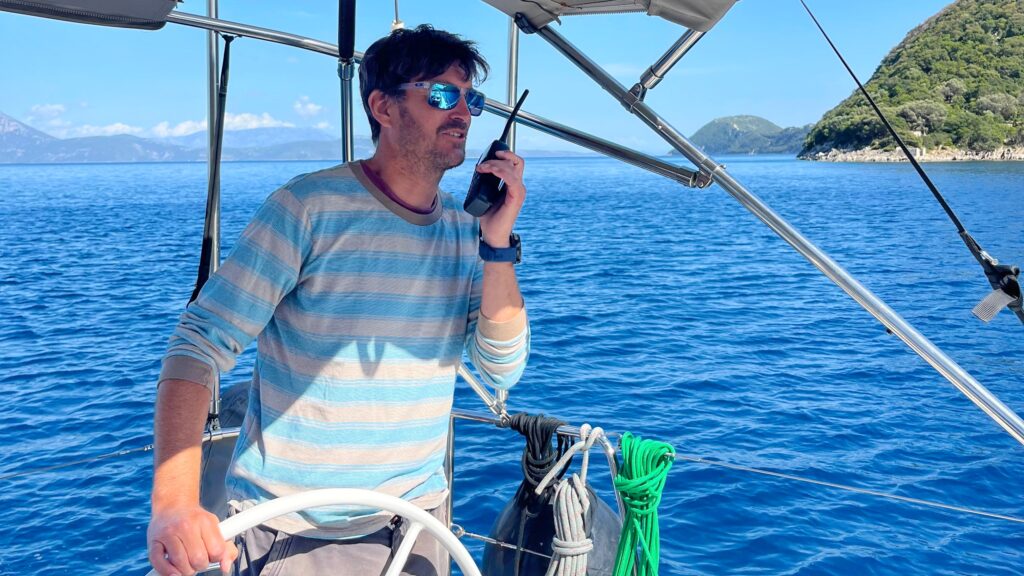
In an emergency—such as an engine room fire, flooding, or Man Overboard—panic causes memory blanks. The app’s Emergency tab pre-populates your vessel’s Name, MMSI, Call Sign, POB, and live GPS coordinates into custom MAYDAY and PAN-PAN spoken scripts, allowing any crew member to read a clear, legally accurate broadcast over VHF Channel 16. If you have correctly input your boat’s details such as Call Sign, Name and MMSI number this is automatically propagated in the scripts.
Zero-Signal Watch Handover
When running night watches, transferring active logbook entries, standing orders, and vessel specs between crew members on separate phones often breaks down when cell towers disappear.
Because the All Winds Toolbox stores data locally in your phone’s memory (IndexedDB), you can tap “Handover Watch” to generate an offline .json trip file. This file can be AirDropped or sent via Bluetooth directly to the incoming watchkeeper’s phone—merging the active logbook with zero cellular coverage.
Ending the Charter: Stress-Free Friday Return
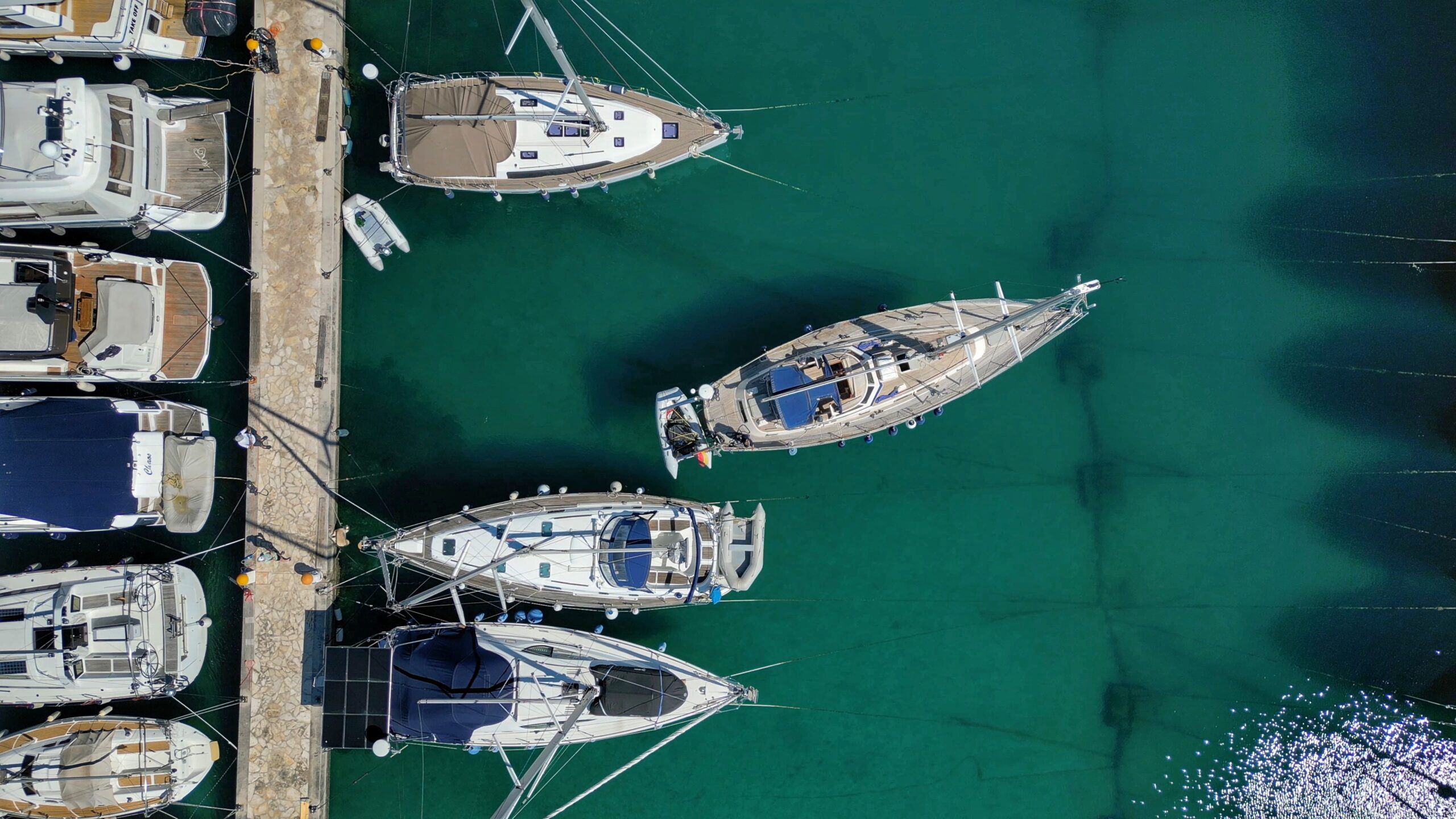
In our First-Time Charter Guide, we give skippers one golden rule for the final day: aim to be back at the fuel dock by Friday lunchtime at the latest.
⚓ Practical Tip: Why bring unnecessary stress into the final hours of a fantastic week? We always aim to return to the charter base by Friday lunchtime at the latest. Sitting peacefully in the cockpit with a cold drink while watching the late afternoon rush is far better than being part of it. Watching 30 boats jostle outside the fuel dock at 16:30 looks like a Friday evening traffic jam at the Colosseum in Rome—it stresses out the base staff, increases the risk of gelcoat damage in narrow marina slots, and ruins the mood right at the end of your holiday. On Day 1 when you first arrive, take a short walk down to the fuel dock to scope out its orientation and plan your Friday approach well in advance.
At the end of your charter, tap “Generate Signed Sea Time PDF” in the app. It compiles your logged fixes, distance calculations, and vessel details into an official PDF document complete with a skipper attestation block—ready for submission to international licensing boards like the DSV, SSA, or RYA.
Join the v0.9 Beta Testing Crew
The All Winds Toolbox v0.9 Beta is 100% free, contains no ads, and requires no account.
Try it on your next trip, test the watch handovers and scope calculations offline, and let us know how it performs in your cockpit!
- Open https://toolbox.allwindsadventures.com in your mobile browser.
- iOS (Safari): Tap the Share button and select “Add to Home Screen”.
- Android (Chrome): Tap the menu (three dots) and select “Install App” or “Add to Home Screen”.
German Language Support is planned in an upcoming update.
Want Hands-on Experience?
Join us on one of our coaching weeks to find out how we developed the app to help you be a complete skipper, and let us work directly with you to achieve your sailing goals.
No. The All Winds Toolbox is built as a Progressive Web App (PWA) that installs directly into your mobile browser’s local memory (IndexedDB). Once loaded or added to your phone’s Home Screen, all calculators, decision matrices, engine checklists, and Mayday scripts function 100% offline in remote anchorages without cellular coverage.
Yes, absolutely. Your depth sounder reads water depth below the hull, but your anchor chain hangs from your bow roller, which sits 1.5m to 2.0m above the waterline. You must add your bow height (freeboard) to your depth reading to get your true vertical drop. If you ignore freeboard in shallow water, your true scope ratio becomes far too steep, causing the anchor to drag when waves pitch the bow. (Our free All Winds Toolbox app includes an instant scope calculator that accounts for freeboard automatically).
Your primary limit is defined by your charter contract and insurance policy, which typically restrict setting sail or leaving port in conditions exceeding Beaufort Force 6 (22–25 knots) without express permission from the base manager. Beyond contractual rules, safe sailing depends on crew experience, sea state, and weather trends.
Inside the All Winds Toolbox app, tap “Handover Watch” to generate a lightweight, offline JSON trip file. You can send this file directly to the incoming watchkeeper’s phone via AirDrop, Bluetooth, or local file sharing. When they import the file, their app automatically merges the active logbook entries, vessel specs, and standing orders.
Yes. The app compiles your logged fixes, vessel details, distance run, and voyage dates into a standardised Sea Time Confirmation document. It includes an official Skipper Attestation and signature block that meets the requirements for international certification boards including the German DSV, Swiss SSA, and UK RYA.
The standard baseline for all-chain anchor rode according to many training organisations such as the RYA is 4:1 (4 metres of chain for every 1 metre of total vertical drop from bow roller to seabed). We use and recommend 5:1 to be well dug in, to give peace of mind. In crowded anchorages or during brief daytime lunch stops, a 3:1 scope can be used if you back down firmly under engine power (2000+ RPM) to verify holding. In heavy weather or overnight squalls, extend your scope to 7:1 or more. If your rode is all rope, then it should be at least 6:1 or more. We have a handy anchor scope calculator on our All Winds Adventures Toolbox App (https://toolbox.allwindsadventures.com)
A skipper’s safety briefing must cover both above- and below-deck operations before leaving the dock. Crucial items include: lifejacket locations and rules, how to operate the VHF radio (specifically Channel 16), fire extinguisher and seacock locations, marine toilet (head) operations, and deck hazards like the boom and preventer lines. We recommend using a digital checklist to ensure nothing is missed in the rush of departure. A basic checklist is available on the All Winds Toolbox App (https://toolbox.allwindsadventures.com)
W.O.B.B.L.E. is a practical daily check routine for marine diesel engines: Water (strainer & coolant), Oil (dipstick level), Belts (tension), Bilge (dry sump), Levels (fuel & header tank), and Exhaust (cooling water flow). (You can follow the built-in W.O.B.B.L.E. checklist inside the free All Winds Toolbox app before every departure).
Join our Crew
Want more practical guides? Join the crew to get our latest sailing tips first.
The All Winds Toolbox and Skipper’s Decision Matrix™ are provided free for personal, non-commercial use and sharing. All commercial rights are reserved. For commercial partnerships or licensing inquiries, please reach out via our contact page.


No responses yet