Analysing the aftermath of the Splitska Vrata collision is essential for any skipper who wants to practice true defensive seamanship. On June 14th, 2026, a devastating accident occurred near the Split Gates (Splitska Vrata) between the islands of Šolta and Brač. Heartbreakingly, this event resulted in the deaths of four people.
The accident left a deep mark on our team and prompted an immediate evaluation of our own onboard routines. This reflection is personal. We passed through that exact area shortly after the incident occurred. On that same day, we heard the DSC notifications and the subsequent, quite unstructured radio traffic from Split Radio. Within a 20-mile radius, we navigated our own crossing with a high-speed ferry and experienced a close shave with a sailing catamaran.
📋 Disclaimer: This analysis is written strictly from our perspective as active sailing coaches, charter yacht owners, and mariners with nearly 40 years of experience on the water. We are not professional Marine Accident Investigators. These observations represent our technical assumptions, with the sole goal of fostering a proactive, no-blame safety culture across the sailing community.
Reconstructing the Collision Angles
Local maritime reports have not yet explicitly defined the exact angle of approach. However, a careful reading of the surviving skipper’s interview published by the Croatian maritime outlet Morski.hr allows us to attempt to make a reliable technical assumption.
An analysis of the aftermath photograph strongly supports this view. The image shows the stern of the sailing yacht—a Beneteau Oceanis 46.1—trapped directly under the starboard bow of the catamaran. The yacht lay at a perpendicular angle to the catamaran’s direction of travel, with its mast and sails submerged in the water.
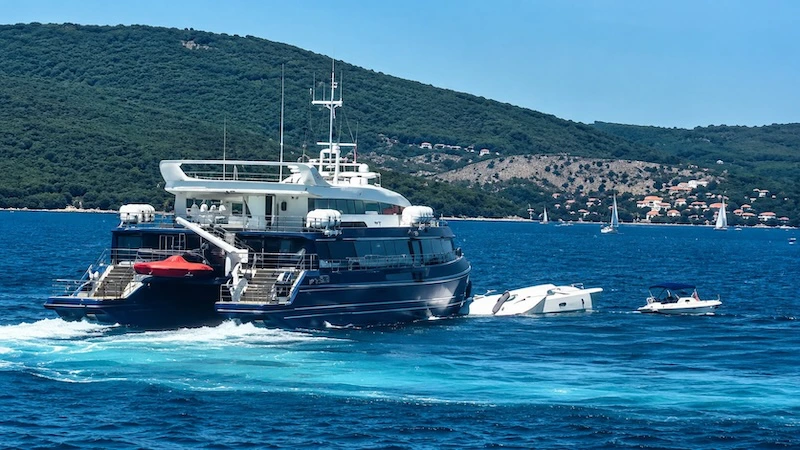
Furthermore, the skipper noted in his interview that he was sitting at the port helm. He was looking across the cockpit centreline when he first spotted the catamaran. Because the sailboat’s starboard helm and starboard aft cabin sustained the direct, catastrophic force of the impact, a clear picture emerges. The catamaran most likely approached from the sailboat’s starboard stern quarter.
The Reality of High-Speed Crossings
During the approach, the charter crew was unaware that the commercial catamaran was travelling at 32 knots. They simply realised that the vessel was moving extremely fast. Consequently, they had very little time to plan an escape route.
The crew ultimately realised the catamaran was not altering its course when it was roughly 500 metres away. At a speed of 32 knots, a distance of 500 metres leaves a closing window of approximately 30 seconds before impact. We do not know if the charter yacht was actively monitoring an AIS receiver. However, we can verify via tracking data that the high-speed catamaran was actively transmitting, as its track was visible on Vessel Finder.
Crucially, an Automatic Identification System (AIS) is an essential electronic tool when used correctly. We request that the AIS transceiver on All Winds remains fully operational at all times. If you ever charter our vessel and find the system offline, you must contact our base and us directly immediately.
Evasive Manoeuvres and Alternative Tactics
When the charter crew determined that the catamaran would not give way, they turned to starboard. They were bearing away in an effort to take evasive action. While this choice was an instinctive attempt to escape, turning to starboard away from a vessel approaching your starboard quarter is highly disadvantageous.
In fact, under the collision regulations for restricted visibility, skippers are explicitly told to avoid a turn to starboard when a vessel approaches from the starboard quarter. Even though this specific tragedy happened in clear daylight, the geometric logic remains completely sound. A starboard turn inadvertently puts you into the path of the approaching vessel.
Second, turning downwind into a light 5-knot breeze instantly drops your apparent wind speed. Consequently, the yacht loses its effective sail power and slows down exactly when it needs acceleration.
The Myth of “Right of Way”
There is no such thing as “right of way” in the international collision rules. Instead, the rules divide responsibility between two specific roles: the vessel obligated to maintain course and speed to remain predictable [Stand-on Vessel], and the vessel obligated to give way and steer clear [Give-way vessel].
Being the vessel required to hold your course is not a privilege or a legal green light. It is a strict obligation to stay at your current course and speed so the other boat can safely calculate its avoidance maneuver. The rules state that you must only alter your course when it becomes absolutely obvious that the give-way vessel is failing to take action. In a high-speed encounter, holding that predictability while a wall of steel charges at you takes immense psychological nerve—but changing course too early can create a catastrophic misunderstanding on the other ship’s bridge.
The Port Turn and Propulsion Alternatives
The skipper stated in his interview that turning to port would not have left them enough time to change the genoa. From a technical standpoint, however, a complete sail change was not required.
The crew could have chosen to tack directly into a heave-to position. Leaving the genoa backed to port would instantly stall the boat’s forward momentum. This dynamic stall might have been enough to let the faster vessel pass safely astern.
Simultaneously, a sudden burst of forward engine power could have pushed the stern out of the danger zone. Most modern cruising yachts utilise common-rail diesel engines. These usually take about 3 to 5 seconds to start. Therefore, there is no need to wait for old glow-plug cycles or warm-up alarms.
Hindsight vs. Crisis Reality
We want to extend our deepest, most heartfelt sympathies to the skipper, the surviving crew, and the families who lost their loved ones. We apportion absolutely zero blame to the crew of the yacht. I don’t know of anyone who could, hand on heart, 100% say they without a doubt would have done anything different faced with the same circumstances.
While it is educationally valuable to analyse these manoeuvres from a technical standpoint, we must acknowledge a critical reality. We are doing so with the immense luxury of complete hindsight. Facing a massive commercial vessel bearing down at 32 knots is a terrifying experience.
In a sudden, split-second crisis (in extremis), human panic is entirely real. Under extreme stress, the human brain naturally defaults to basic survival instincts. Anyone who sits back in an armchair and claims they would have handled this perfectly is occupying a very dangerous space on the Dunning-Kruger curve.
Navigating Traffic Density and License Ignorance
The summer waters of the Adriatic are a crowded powder keg. Many holiday charterers lack practical sea time. Consequently, they mistakenly bring basic road-driving or motorboat assumptions onto a sailing boat.
For instance, in October 2025, we were test-sailing All Winds through the Split Gates while beating upwind on a starboard tack. Simultaneously, another sailboat was running downwind under its jib alone on the exact same tack. Under international sailing rules (COLREG Rule 12(a)(ii)), the windward boat must keep clear of the leeward boat.
Therefore, we were legally the stand-on vessel. Yet, as we actively took evasive action to prevent a collision, the other crew began shouting at us. They aggressively claimed they had the right-of-way because they were “coming from the right”. They were incorrectly applying basic motorboat crossing rules to a clear sailing situation.
Learning from Our Own Weaknesses
It is easy to point fingers at commercial crews of high-speed ferries or holiday charterers. However, the hardest part of genuine seamanship is looking directly in the mirror. None of us are perfect.
On that very Sunday, June 14th, 2026, I was on All Winds just 20 miles away from the accident. Earlier that morning, we had departed Lovište under perfect champagne sailing conditions, flying our Gennaker. Soon after leaving, a high-speed ferry approached from our port side.
I held our course and carefully monitored his trajectory as we were legally the stand-on vessel. He eventually altered his course by a few degrees to pass close astern. Because we identified him early, we had the luxury of time to evaluate the situation safely. Shortly after this encounter, we heard the DSC distress alert and some unstructured voice transmissions from Split Radio. Having been involved in real Mayday operations in the past, I noted that nothing suggested a major accident, and I mistakenly assumed it was a false alarm.
The Danger of Blind Spots
Shortly afterwards, the wind died completely while we were motoring between Šćedro and the Paklinski islands. I engaged the autopilot, scanned the horizon for traffic, and noted a single vessel far ahead that posed no threat. I then left the helm for a brief moment.
During those few minutes, I completely missed a large charter catamaran approaching from our starboard side. Ironically, it was flying a massive Swiss flag. When it suddenly passed close astern, I could not tell you if they had to alter their course to avoid us or not! In that crossing situation, we were clearly the give-way vessel.
After cruising through uncrowded waters for months, this was a severe wake-up call. Croatia features immense maritime traffic, and a simple few minutes’ human lapse is all it takes to create a potentially catastrophic blind spot. At 30 knots, a fast vessel covers a full nautical mile in just 120 seconds.
Designing Habits for Safer Seamanship
Developing a defensive mindset on the water does not mean operating like an infallible computer. We are humans. We experience fatigue, suffer from distractions, and possess clear physical limits. To protect our crews and vessels from our own biological weaknesses, we must design watchkeeping routines.
Out of this profound tragedy, our goal is to highlight how the sailing community can protect itself by reducing watchkeeping to two simple habits:
- Scan Frequently and Completely: Actively scan 360 degrees around your vessel, checking your blind spots far more frequently than you think is necessary. Never assume that a clear horizon will remain clear for more than a few minutes.
- Formally Appoint a Spotter: If you are cooking, analysing a chartplotter, or dealing with a sail that completely blocks your forward vision, explicitly assign a crew member to monitor your blind spots.
True seamanship is not about pretending you never make mistakes. Instead, it is about recognising your vulnerabilities, learning from those close shaves, and building those lessons directly back into your deck routines. We cannot guarantee perfect safety on the water, but by shifting our focus toward the human factors that drive risk, we can actively minimise our exposure to danger.
A Continuous Commitment to Sea Safety
Our thoughts remain with everyone affected by the events at Splitska Vrata. As a community of mariners, the best way we can honour those lost is by committing ourselves to a higher standard of shared awareness, mutual respect, and defensive vigilance on the water.
We invite you to share your thoughts in the comments below. What watchkeeping or safety habits do you enforce on your boat to protect your crew from blind spots and fatigue? Let’s keep the dialogue respectful, constructive, and focused on making the seas safer for everyone.
Do commercial ferries always have right of way over sailboats at sea?
No. Under international maritime law (COLREGs), there is no blanket rule granting a commercial ferry priority over a recreational sailboat simply because of its size or commercial status. In an overtaking situation, the overtaking vessel must keep completely clear, whether it is a fast ferry or a small yacht. This common myth often arises from inland lake regulations—such as those in Switzerland and Germany—where scheduled commercial vessels hold legal priority. Applying inland lake assumptions to open coastal waters creates highly dangerous confusion on the water.
Under COLREG Rule 17, the stand-on vessel is legally required to maintain its course and speed. This is a fundamental requirement for predictability. A give-way skipper can only calculate and execute a safe passing distance if your trajectory remains completely steady. If you alter course prematurely, you destroy that predictability. If both vessels execute an evasive manoeuvre at the same time, they frequently turn directly into one another’s paths, turning a close pass into a catastrophic collision.
Under COLREG Rule 9 (Narrow Channels), a sailing vessel or any craft under 20 metres in length is legally required “not to impede” the passage of a vessel that can safely navigate only within that specific channel or fairway. This means you must not navigate in a way that forces a deep-draft commercial vessel to alter its course or slam its engines into reverse to avoid you. When transiting tight straits, island gates, or commercial fairways, recreational skippers must actively stand clear and give the commercial hull a wide berth, regardless of their sailing tack.
While size alone does not dictate right of way, specific operational constraints do. Beyond narrow channels, a sailboat must not impede large vessels navigating within a formal Traffic Separation Scheme (TSS) under Rule 10. You must also give way to any vessel legally displaying shapes or lights indicating it is “Constrained by her Draft” (restricted to a deep-water channel) or “Restricted in her Ability to Manoeuvre” (such as a vessel restricted by the nature of her work). Outside of these specific legal frameworks—Narrow Channels, TSS, Draft, or RAM constraints—standard crossing and overtaking rules apply to commercial and recreational hulls absolutely equally.

No responses yet