
You passed your exam, you booked the charter, and suddenly, you are the one carrying the responsibility. Now what?
Sailing schools give you scaffolding. Your peers share your experience level, the boat is perfectly prepared, and an instructor is always there to catch the pieces if things go wrong.
But the moment you step onto a charter yacht as the skipper, that safety net disappears. You are the ultimate authority, often managing a crew with far less training than the teams you trained with.
Navigating the human element on board is just as critical as reading the chartplotter. Here is how to map your crew dynamics so your first independent voyages don’t turn into high-stress trials.
The Confidence Cycle: The Dunning-Kruger Effect
When you first pass an exam (Day Skipper, Hochseeschein, or SKS), it is easy to mistake a piece of paper for absolute capability. In reality, a certificate is simply an invitation to begin true, experiential learning.
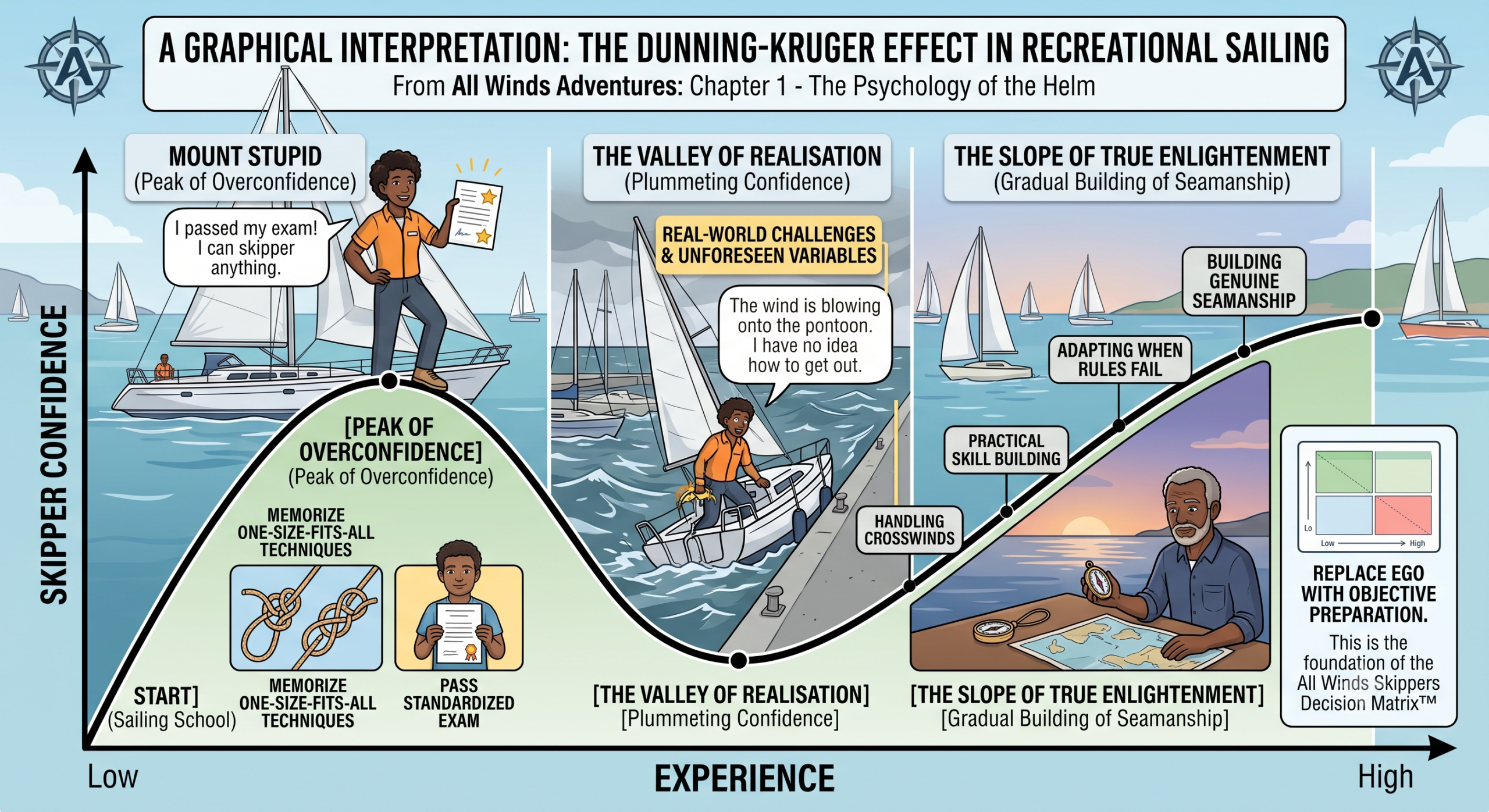
This cycle resets in iterations throughout your sailing career:
- You master lake dinghies, then feel like a beginner again on a coaching yacht.
- You master coastal island-hopping, then face a new learning curve going offshore.
Expect these resets. A good skipper accepts that they are starting a process, not finishing one.
1. Inexperienced Friends: Managing the “Oracle” Illusion
Non-sailing friends will automatically assume your new qualification makes you an all-knowing master of the sea.
- The Risk: You either overcompensate with false certainty or internalise the stress silently.
- The Strategy: Clear the air before leaving the dock. Assign simple, non-technical jobs, manage expectations early, and deliberately sail well within your comfort zone while building miles.
2. Experienced Friends: Sorting Advice from Stress
Sailing with experienced peers offers great support, but it introduces a different cognitive friction. There are as many ways to handle a line or drop an anchor as there are sailors on the water.
- The Risk: Getting sidetracked or stressed by a crew member questioning your workflow.
- The Strategy: As skipper, you must use the method that keeps you calm. Process their input, use their muscle power, but maintain a firm boundary regarding your personal stress limits.
It’s important to take it on board that your experienced friends might have some good advice, some handy tips and tricks or new skills that you might be able to learn from them. It’s important to make sure that you are comfortable with what you are doing and that these well-intentioned offers of help create a positive experience rather than additional stress. If you are the skipper, ultimate responsibility sticks with you, and you have to make sure you have a good feeling about what decisions are made.
3. The Inexperienced Partner: Balancing Roles
The dream of sailing into the sunset together can easily turn into a relationship strain if the communication dynamic breaks down on deck. Until you function as an intuitive team, you must be capable of single-handing the vessel while delivering calm, concise directions.
⚓ Notes from the Logbook: We recently watched this go wrong in a crowded anchorage. A boat began dragging its anchor in a sudden blow. The female partner was on the bow wrestling a malfunctioning windlass in total panic.
The male skipper remained surgically attached to the helm, burning out his bow thruster and shouting orders. Because he lacked the boat-handling confidence to temporarily leave the wheel and assist her on the foredeck, the situation escalated into a toxic shouting match.
Avoid rigid stereotypes. Take progressive baby steps, learn to share roles flexibly, and ensure you are both building functional competence before you face demanding conditions.
4. The Experienced Partner: Safe Progression
This is one of the strongest configurations for a new skipper. You have an established baseline of personal trust paired with a reliable sounding board on deck.
- The Strategy: Keep your initial challenges modest. Focus on how you communicate as an independent, shorthanded team, and use their presence to steadily expand your operational limits.
5. The Family Crew: High Emotional Stakes
Taking your immediate family out can be the most intimidating configuration of all. You hold absolute responsibility for the people who matter most to you; they are usually inexperienced, and you have zero professional backup.
- The Strategy: Keep trips short, conservative, and comfortable. Plan light-wind or downwind coastal legs to build their confidence, and focus on keeping the experience enjoyable rather than highly technical.
6. A Group of Strangers: Avoid Early On
Stepping onto a vessel with a crew you do not know is highly discouraged for your first few independent commands.
- The Risk: You cannot verify their true capability, their communication habits, or how they react to pressure. A bad suggestion from an unverified stranger can easily become the first link in an accident chain. Learn to manage friends and family first.
Calibrating Your Strategy: The Next Step
Matching your crew’s capability to the prevailing marine forecast is the ultimate mark of good seamanship. To help new skippers evaluate their readiness on deck, we developed a practical operational framework.
You can access our digital reference tool directly via our First-Time Skipper’s Guide.
If you want to accelerate your transition from a newly certified sailor to a truly confident independent skipper, we design our dedicated training weeks to address these exact human and technical dynamics. Operating on board our own cruising yacht, All Winds, in Croatia, our coaching provides hands-on practice in decision-making, short-handed docking, and crew communication under the guidance of supportive professionals.
Explore Our Skipper Confidence Weeks Today—or share your own early crew management experiences in the comments below.
Sailing with experienced peers is a fantastic asset, but it can introduce friction if they prefer a different workflow. At All Winds, our core philosophy is about building an adaptive toolkit rather than memorising rigid scripts. Use their presence to expand your options: learn as many different ways to handle a line or execute a berth as possible, but use the specific tool that keeps you comfortable in that exact situation. For a deeper look at how to balance absolute rules with practical adaptability on deck, read our guide to Practical Seamanship Philosophy
The most effective way to lower the pressure on an inexperienced partner is to ensure you are personally competent enough to shorthand the vessel if a line jams or a winch slips. When your partner knows that their assistance is a helpful bonus rather than a critical dependency, their anxiety drops significantly. Focus on breaking down traditional, rigid deck roles and learn how to share the workload flexibly based on physical leverage. We break down exactly how to manage these interpersonal communication shifts in our article on Couples Cruising
It is not inherently a bad idea, but it requires a massive shift in how you approach your voyage. Taking your immediate family out means carrying absolute responsibility for the people who matter most to you, often with zero experienced backup on deck. If you tackle this configuration for your first independent command, you must dramatically adjust your expectations and keep your operational choices conservative. For a step-by-step breakdown on how to map out a safe, stress-free layout for your very first independent trip, access our comprehensive First-Time Skipper’s Guide
The biggest mistake isn’t a bad docking manoeuvre; it is poor planning. New skippers naturally lack the deep experiential data required to build a realistic, flexible itinerary. They try to achieve too much—planning massive passages or tight schedules that leave absolutely zero margin for weather shifts or crew fatigue. Good seamanship means acknowledging your current limits and biting off bite-sized, highly manageable challenges. Plan short, simple coastal hops with easy entry ports so you can build your confidence progressively without overloading your crew.
Absolutely, provided you don’t project blind fear or panic. The truth is that all good skippers feel a degree of nervousness—in fact, you should be deeply worried about the skipper who claims they never get anxious. Nerves are a healthy biological radar that keeps you honest, alert, and focused on safety. A close friend of mine—a professional delivery skipper, Yachtmaster Ocean, Instructor, and global circumnavigator—confessed to me that he still gets nervous when taking command of an unfamiliar boat (even when it was a brand-new Swan 65). Acknowledge the butterflies, use them to double-check your safety lines, and brief your crew with calm transparency.

No responses yet