
Quick Guide: Tips for Yacht-Launching Watersports
- Gear Storage: Kitesurfing gear easily compresses into lockers. Windsurf boards and aluminum foils require heavy-duty bags and padded deck storage to prevent gelcoat damage.
- The Golden Rule: Always stay upwind of your vessel. A standard charter dinghy with a 2.2HP outboard will struggle to rescue you in 25 knots of wind.
- Anchor Safety: Launching from the boat puts extra stress on your ground tackle. Never leave the yacht unattended in high winds unless you have absolute trust in your anchor and snubber.
- The Freshwater Myth: Do not rinse sails and kites with fresh water before packing them in dark lockers. Salt acts as a natural preservative against mildew; trapped fresh water breeds it.
The Instagram dream of windsurfing, kiting, or foiling from a cruising yacht into a perfect 20 knots of wind sounds like Nirvana. But if you’ve ever actually tried it, you know it’s not quite as straightforward as it seems.
Boats, heavy foil components, and massive windsurf rigs do not naturally mix. Launching a 120-litre slalom board or a kite off the stern of a swinging 45-foot yacht is a logistical challenge. If you want to seamlessly blend cruising with high-wind watersports, you just need a good system. Without one, you risk kinking your sails, denting your deck, or finding yourself drifting downwind of your only way home.
Here is how we make the dream actually work at All Winds.
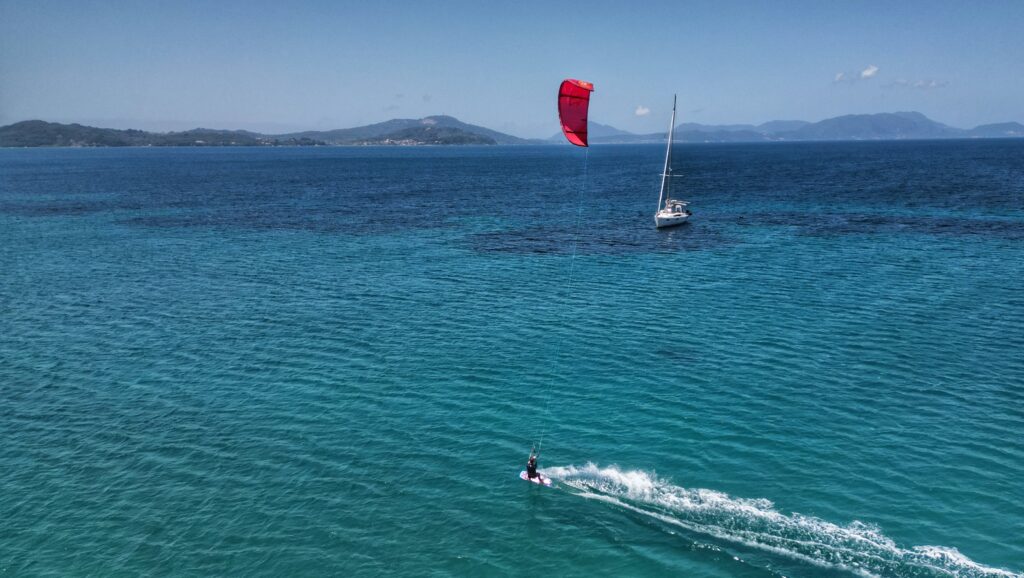
1. Location and The Anchor Trust Factor
You can’t just drop the hook anywhere the wind is blowing. You really need one of two setups:
- The Beachside Marina: The easiest option. Find a marina physically right next to a launch beach. The yacht is safely tied up, there are no dinghy logistics, and you just walk the gear over. Good examples of this setup are Maccinaggio in Corsica, San Vincenzo and Cecina in Tuscany or Vieste in Appulia.
- The Protected but Windy Anchorage: It sounds like a contradiction, but that is exactly what us wind junkies are looking for! If you want to launch directly from the boat, look for a headland, land spit, or lagoon where the anchorage is protected from the sea swell (so the boat isn’t rolling violently, the chop is flattened and you won’t have shock loads on your anchor), but clean wind still blows across the water. Pantera on Dugi Otok in Croatia during the off-season is perfect for this, as is Vasiliki in Greece.
Apps like Windy can be great for this. By zooming in, you can actually see the topography of the area you are looking at and with the different model comparisons it’s possible to get a good idea of what you can expect along with swell and how it might affect your chosen anchorage.
The Anchor Reality Check: Do not underestimate the risk of leaving your yacht unattended in high winds. If you are on a charter boat with questionable ground tackle, do not leave the boat to its own devices in 25+ knots of wind. Launching directly from the boat requires absolute trust in your anchor. If you don’t have that trust, head to a marina. (18 to 20 knots is enough for most wind sports, and for a decent anchor with a good amount of chain out and a snubber, it is manageable. Don’t go in stronger winds until you have your system dialled in at 15 to 20 knots! Remember, when the wind speed doubles, the wind resistance quadruples and the sea state will start shock loading your anchor!)
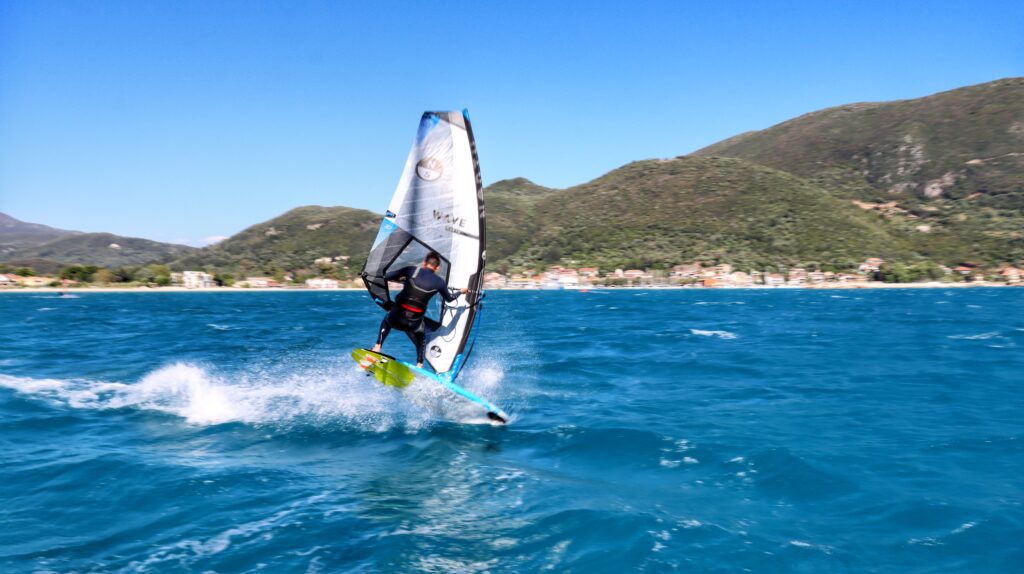
2. The Tetris Game: Storing Gear
You have to be creative—and careful—about storage.
- Kitesurfing: Easily the most boat-friendly. Most kite gear is highly compressible and fits easily into a standard cockpit locker or a spare cabin.
- Wing Foiling: Small wing boards might fit in a deep locker or be tied securely in the dinghy on deck. However, foil components are heavy hazards. While carbon is sharp, aluminium foil masts and fuselages are incredibly dense. Dropping an aluminium fuselage will instantly crack your gelcoat. They need dedicated, padded protection.
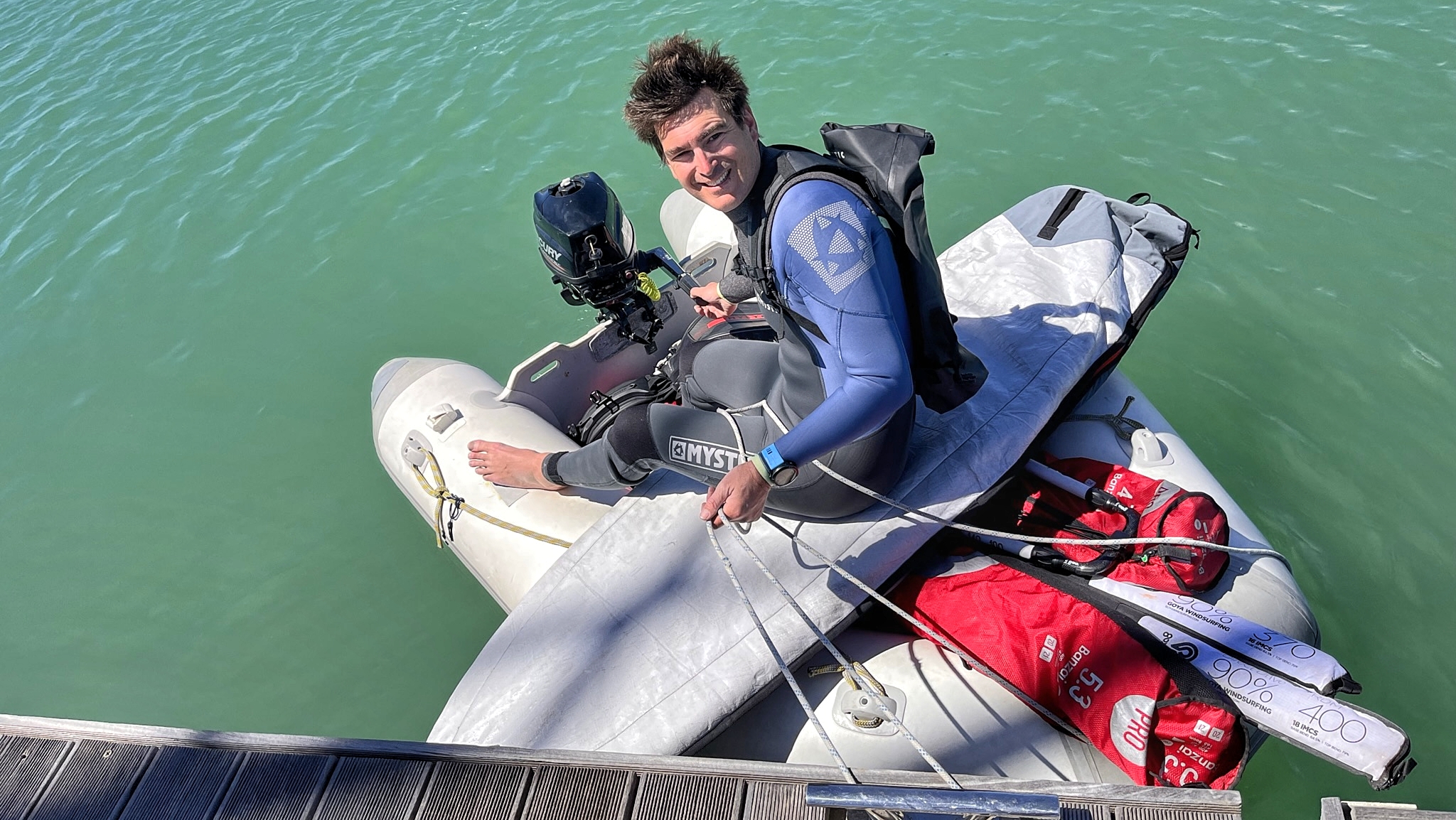
- Windsurfing: This is the biggest logistical challenge. Small wave boards (<100L) can usually be manoeuvred below deck. Larger gear, like a 120-litre slalom board, simply won’t fit down a companionway. Unless you have a catamaran with a trampoline, large boards must go on deck—usually in heavy-duty quiver bags strapped securely to the guardrails, rigged so they cannot be washed overboard or damage the stanchions.
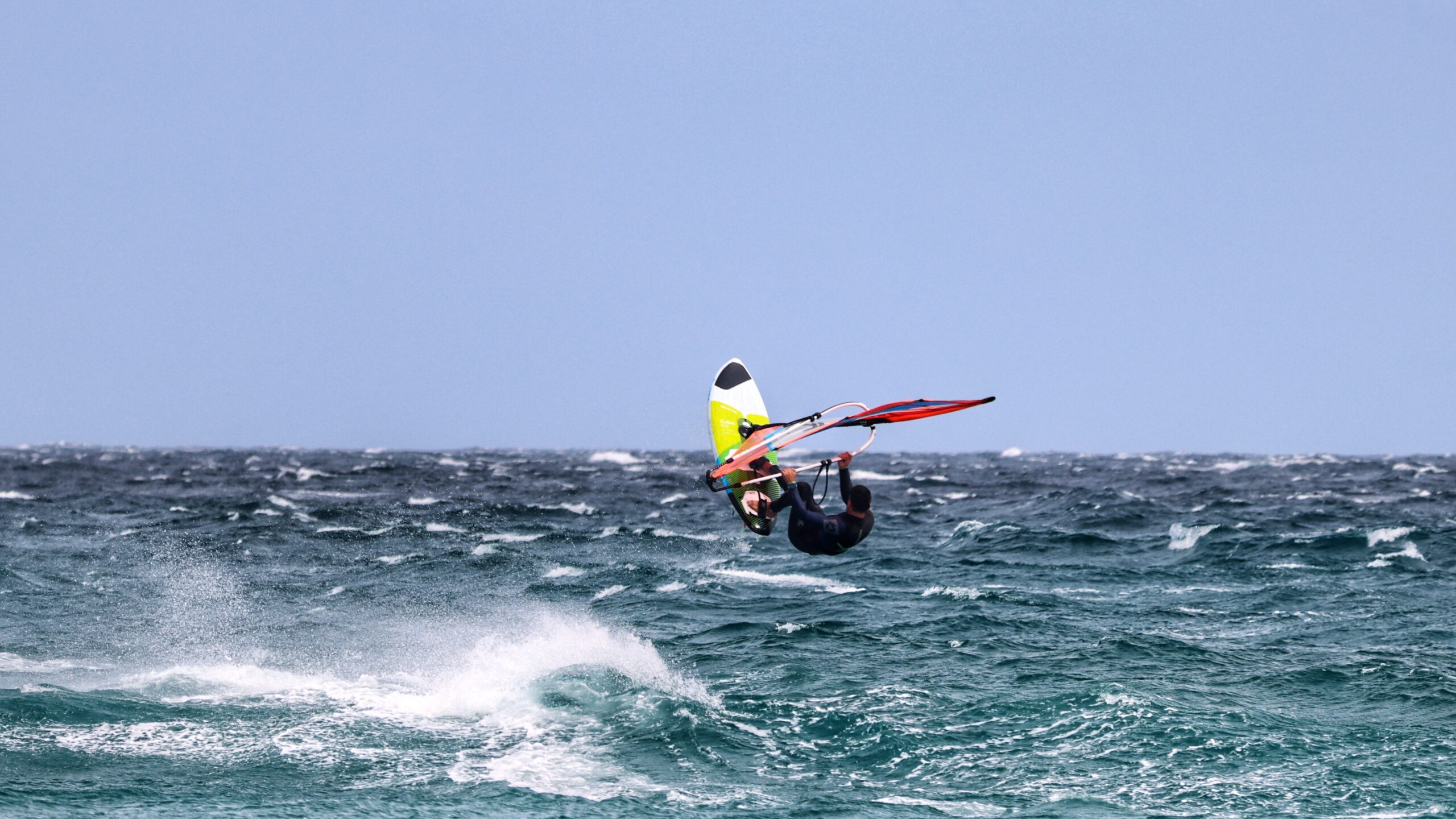
3. The Swim Platform Setup
Rigging on grass is easy. Rigging on the back of a boat requires the right boat geometry, good technique and a solid system. The ideal setup is an open rear cockpit with a large, flat, fold-down swim platform. (Note: On a very large yacht of 50+ feet, you can sometimes rig on the foredeck. But on a typical 40-foot cruiser, you will be fighting the mast, shrouds, and anchor windlass.)
- Winging: Modern swim platforms are great for inflating wings and assembling foils. Just keep an eye on your hardware—dropping a foil screw through the teak deck grating into the ocean ruins your session before it begins.
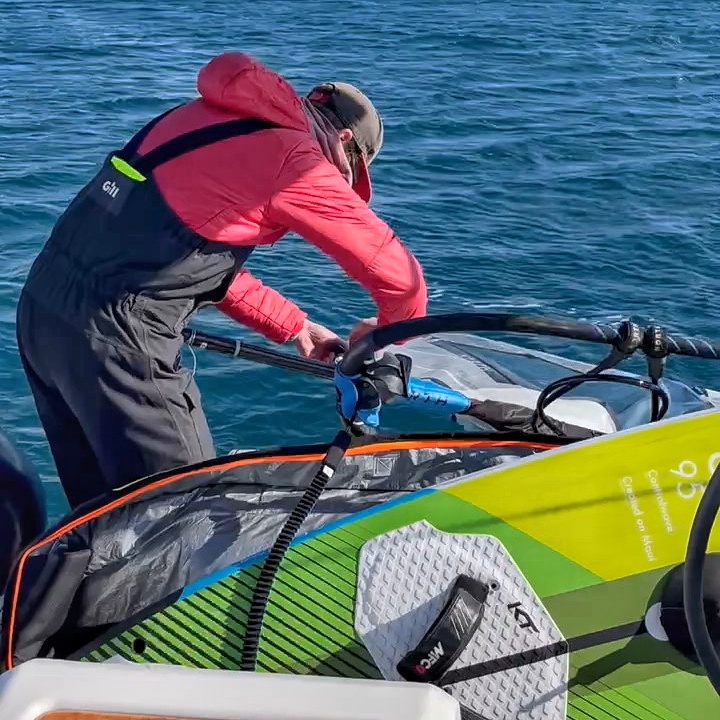
- Windsurfing (The In-Water Trick): Rigging larger sails on the back of a boat requires care to avoid kinking the monofilm. Keep the sail rolled up as you carefully slide the mast up. Crucially, ensure the two-piece mast is pushed completely together at the ferrule. If there is a gap, the mast will snap the second you apply downhaul tension. Once the mast is secure, drop the rig into the water. Sit on the swim platform, tension the downhaul while the sail is floating alongside, attach the boom, connect the board, and start directly from the stern.
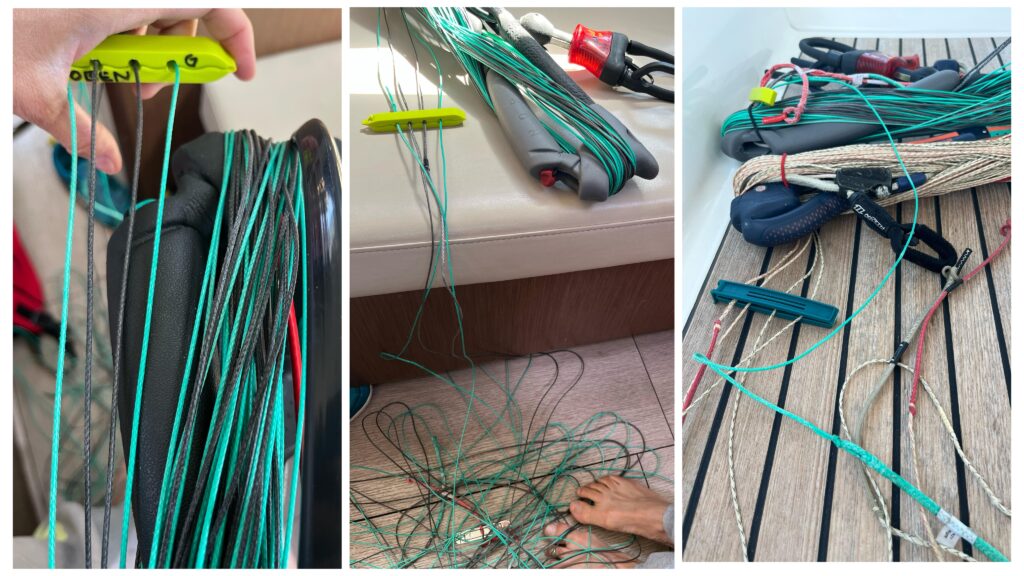
- Kitesurfing: Ideally, take the dinghy to the beach to rig. If you have to prep on the boat, you can carefully walk the lines up the side deck, around the forestay, and back down to untangle them, or you can float the bar downwind in the water to separate the lines.
4. Launching and Landing
Because the boat is anchored facing directly into the wind, the hull, sprayhood, and bimini create a massive dead zone of turbulent air directly behind the swim platform.
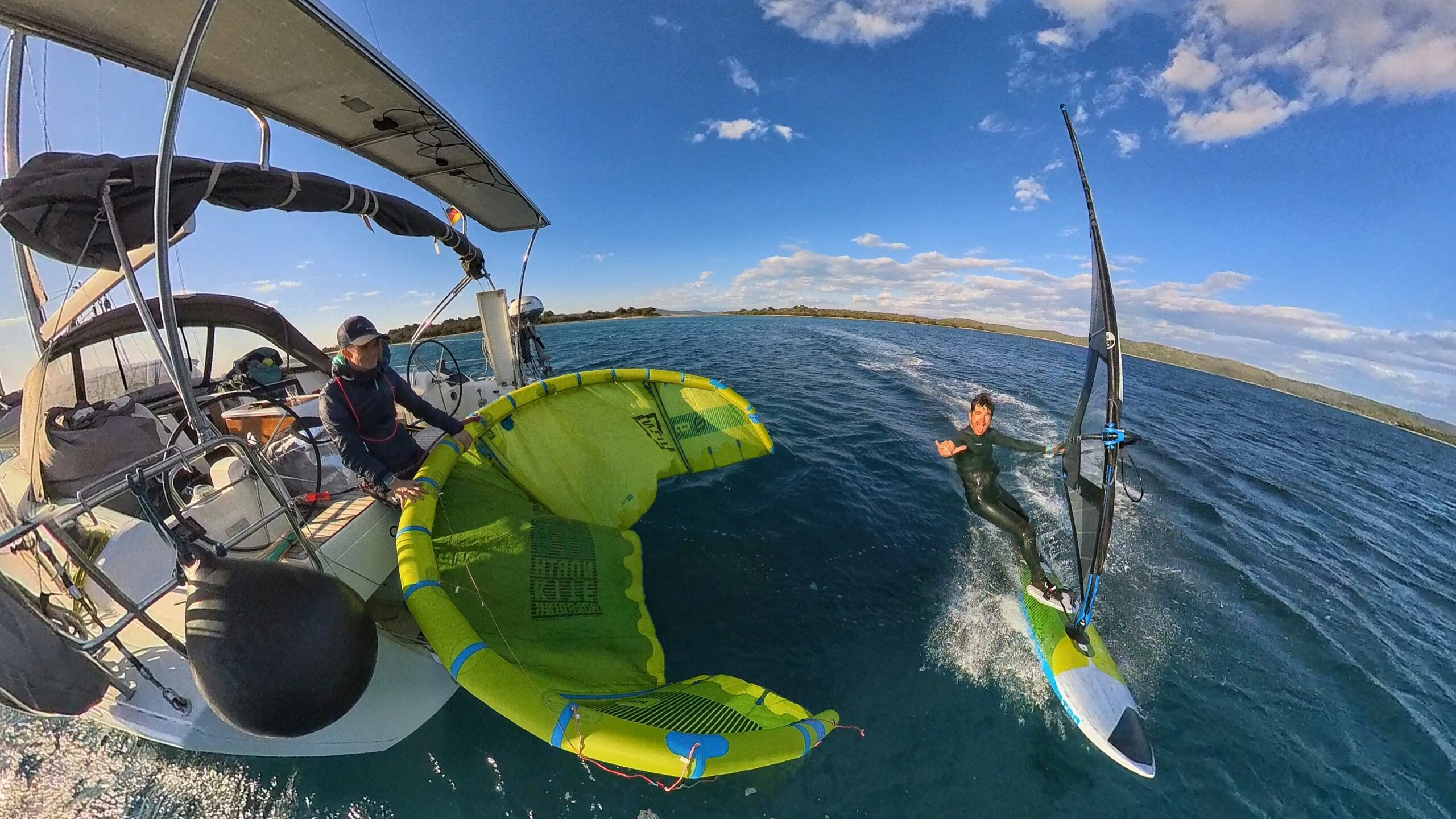
- The Launch: You cannot launch a kite directly behind the boat. You have to drift the lines and the kite well out to the side, completely clear of the wind shadow. If you are windsurfing on a low-volume sinker board, attempting a beach start directly off the swim platform is tricky—you’ll have zero wind power in your sail until you drift backwards and clear the stern.
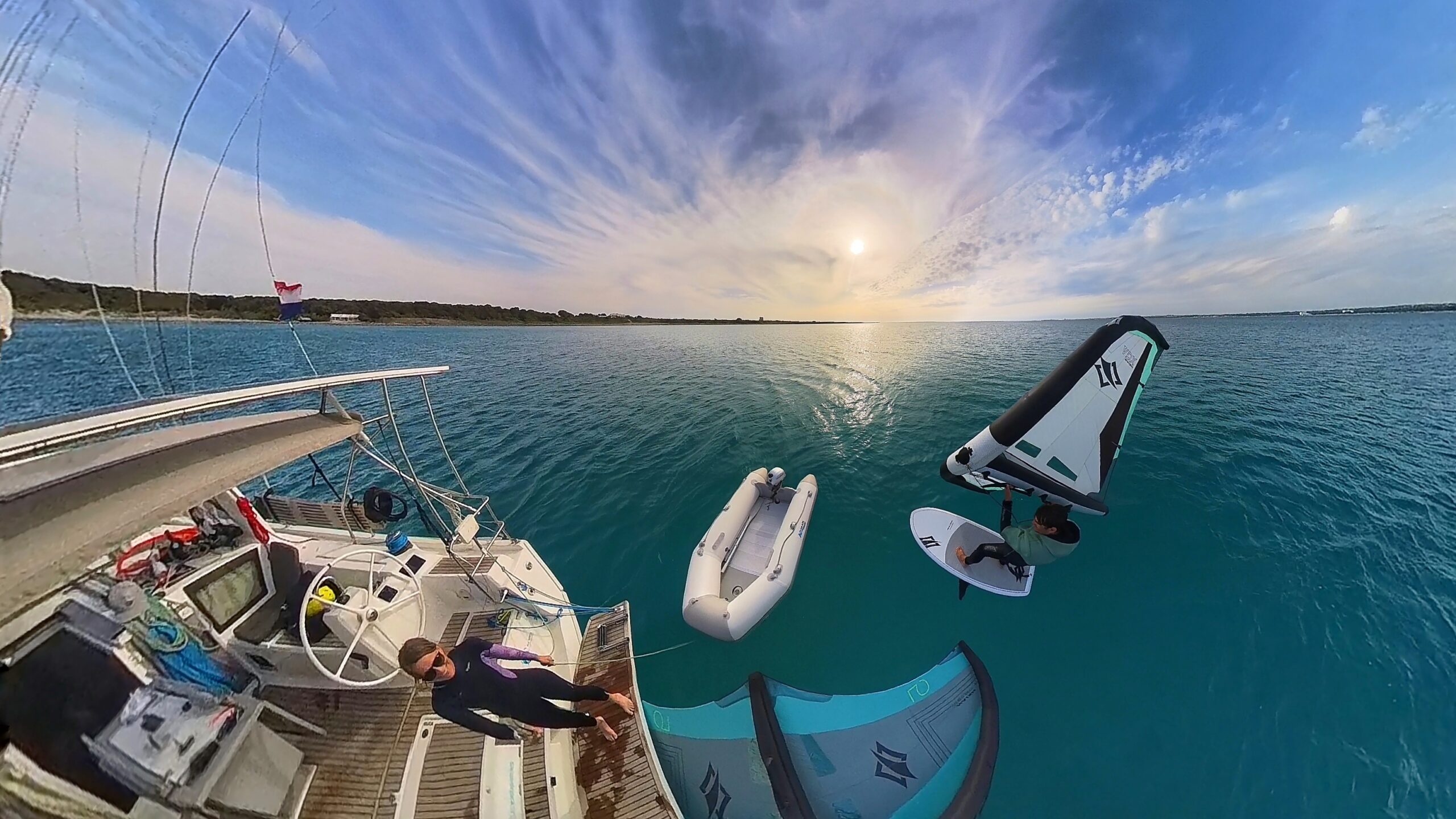
- Getting Back Aboard: Approaching a fibreglass yacht in 25 knots of wind can be intimidating. Slow right down as you approach the transom and drop the sail, kite, or wing just as you make contact. Alternatively, if you want a softer target, tie a floating line to a fender and trail it 10 to 15 meters off the stern. Aim for the fender, grab the line, drop your gear, and pull yourself in.
5. The Golden Rule: Stay Upwind
When you launch from a beach, you can afford to do the “walk of shame” downwind. When you launch from a boat, downwind might be the far side of a shallow lagoon, a rocky lee shore, or the open ocean. Always stay upwind of the boat. If the wind suddenly drops or you break gear, you must be able to drift or slowly paddle downwind back to your own swim platform.
6. The Dinghy Rescue
Having the dinghy ready is a good idea, but try to rescue someone against 20+ knots of wind in a tiny inflatable dinghy with a 2.2HP outboard, and you’ll quickly realise its limits. Here is the reality of most charter tenders: those little outboards usually don’t have a neutral gear (the prop just stops at idle), and they definitely don’t have reverse. Combine that with a flat-bottomed dinghy that blows across the water like a leaf, and they are actually way more difficult to manoeuvre in a blow than a proper RIB with a 10HP engine.
If a rescue is necessary:
- Always approach a person in the water from downwind.
- Keep the propeller away from the person and the gear. Since you likely don’t have a true neutral, hit the kill switch before trying to make physical contact.
- If you are picking up a kiter, pull the lines aboard before restarting the outboard so you don’t stall the engine when you need it most.
7. “Skipper” Off the Boat
While you might often do this in calm conditions to go for a walk, a coffee or dinner ashore, doing this to go and do some windsports is by its nature a different kettle of fish. Conditions that allow for good windsports automatically put extra stress on your ground tackle by their nature. If you are the legally designated skipper, remember: you are still the skipper, even if you are a mile away strapped to your kite. While the rest of the crew might enjoy watching the session, if there is any doubt in your mind about the boat dragging its anchor, you need to stay close enough to act immediately, or simply skip the session.
8. The Pack-Down
The fastest way to ruin a cruising yacht’s interior is to drag wet, sandy gear down the companionway. But here is the biggest misconception: Do not waste your precious freshwater budget rinsing your sails and kites. Fresh water packed away in a dark locker breeds mildew; salt water does not. If your gear is used regularly in salt water, it doesn’t need a fresh rinse.
- The Real Enemy is Sand: Sand scratches carbon, monofilm, and gelcoat. Give your gear a quick wash in the ocean to get the sand off before bringing it aboard.
- Zip Maintenance: Make sure there is no heavy salt residue jamming your board bag zippers. Keep them clean and well-lubricated.
- Let everything air-dry in the cockpit before it gets packed away.
We don’t like to leave gear tied to the stern of the boat overnight; it’s a prop wrap waiting to happen if the anchor drags overnight or you have to move for some unforeseen reason. Derig and store the gear when you’re finished to reduce the risk of something going pear-shaped overnight.
The Payoff
Blending windsports with cruising isn’t always easy, and the logistics are rarely as glamorous as the social media reels make them look. It requires discipline, good storage planning, and absolute trust in your ground tackle.
But when you get the system right—when you drop the hook in a perfectly protected bay, rig your gear without a hitch, and step off your own swim platform into 25 knots of clean wind miles away from the crowded beaches—there is absolutely nothing else like it in the world. It is the ultimate freedom.
At All Winds Adventures, we don’t just teach you how to pass a sailing exam; we teach you how to actually use your boat as a base camp for the sports you love. If you want to dial in your boat-handling and safety protocols to manage these kinds of sessions, join us for a Take the Helm Skipper Coaching Week in Croatia. Or, if you just want to show up, step on a board, and let a professional worry about the anchor, book a Private Charter with us this season.
Leave the “always” and “never” at the dock, pack your gear, and let’s go find some wind. If you require some equipment for Windsurfing. Kiting or Winging then get in touch, we are suppliers for North, Naish, Slingshot, and much more.
Yes, but you cannot launch it directly behind the transom due to the massive wind shadow created by the boat’s hull and bimini. You must drift the lines and the kite and steer it well out to the edge of the wind window and into clean air, or use a dinghy to transport your rigging setup to a nearby beach.
Large volume boards (>100L) generally will not fit down a standard companionway. They should be stored on deck in heavy-duty board bags, securely lashed to the guardrails and stanchions on the side decks, clear of the side-stay walkways or tied to the dinghy. Be careful that all sheets can easily work around the gear. We’ve learned this the hard way when gybing in 25 knots at 6 am and the jib sheets almost sent one of Dave’s boards overboard!
No. Unless you are storing your gear away for the winter, do not rinse it with fresh water before putting it in a boat locker. Fresh water locked in a dark environment causes mold and mildew. Salt water acts as a natural preservative against fungi. Always focus on rinsing off sand using ocean water instead.
For intermediate systems, 15 to 20 knots is the ideal sweet spot. It provides plenty of power for kiting, winging, or windsurfing while remaining highly manageable for a properly set anchor with a good snubber chain system. Do not attempt boat launches in 25+ knots until your team’s workflow is completely flawless. Waves are arguably more important as you do not want waves causing snatching loads on the anchor and threatening to pull it loose.



No responses yet